
Friday, December 18, 2020

The teacher becomes the learner: Self-care

Continuing my intentional path to explore what I can learn to become a better teacher in a remote synchronous online learning environment, here's part 5. I am participating in a Faculty Learning Community (FLC) sponsored by the Division of Online and Strategic Learning of Ball State University. I will periodically post my reflections in this blog to document my progress, and to serve as a resource for a future me, as I come back to review these posts. Perhaps there will be something of use for other readers that aren't me.

Module 5: Self-care

This module focused on our self-care. The following notes summarize what I gleaned from the module.

From Self-Care Strategies for Faculty: How to Care for Yourself & Others During COVID-19 (Hitt, 2020), I gleaned these practices for mental, physical, and spiritual health.
  • Mind
    • Limit unnecessary screen time
    • Journal, write, blog
    • Comforting workspace
    • Be creative
  • Body
    • Stay hydrated
    • Healthy snacks
    • Exercise
  • Spirit
    • Meditate
    • Spend time in nature
    • Connect to community organizations

 Other things to consider from COVID-19: Resilient Educator Toolkit.

  • Stay calm
  • Be informed
  • Self care
  • Stay healthy
  • Create a plan—routines
  • Maintain balance
  • Stay motivated
  • Think positively
  • Embrace change
  • Move forward

A step in time…

When I was in my twenties and thirties, I enjoyed jogging. Then, for a few years, I didn't exercise much. For the last decade, I've taken up speed-walking. My goal for the last five years has been to walk at least as many miles as the year number. That means for this year I need to walk 2020 miles to meet my goal, or 35-40 miles per week. 
 
A man in a canoe on a lake
When COVID19 hit in mid-March and the recreation center closed, I didn't do as much walking as I was used to. I missed it, but not enough to convince myself to go outside and walk in the cold. Once the warmer weeks of May arrived, I spent much more time walking, and felt more myself. As I write this, I have 116 miles to go to reach my goal, and 14 days to do it in. COVID19 set me way back; previous years I've been 250-500 miles over my goal. 
 
Speed-walking has obvious health benefits, and is a great stress-reliever, but I find walking also provides a time for my mind to wander and think about things it might not otherwise think about.

Sunset over a lake
My happy place (one of them)

Starting as a teenager, I've been to the Boundary Waters Canoe Area Wilderness (BWCAW) in extreme northeastern Minnesota—way up in the little point on the Canadian border—at least six times for multi-day trips. It is one of my favorite places to be. Unfortunately, it's been seventeen years since my last trip. As a way to de-stress a bit (as I write this, I’m in the midst of finals week and learners are submitting their work which I then need to evaluate), I decided to take some time to look through photographs I took during my last two trips to the BWCAW.
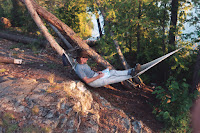
A man in a hammock

I thoroughly enjoyed looking through my many photographs to select fifty images to include in a photo essay. The joy came partly because I enjoyed looking at the images and remembering when I captured them, but also because they were two weeks I spent with my son when he was a teenager. It was good to relive those wonderful weeks, and I now have a resource I can look at whenever I want to go to a happy place to de-stress. I've provided a few of the images here, but you may view the full PDF, if you wish.
 

Trees reflected in a lake

A final thought

Remember that self-care does not mean you have to do it all yourself. Talk and interact with others. And if you are experiencing challenges beyond what you can address, contact someone you trust. For immediate help, call 911 or the National Suicide Prevention Lifeline at 1-800-273-8255.


Thursday, November 12, 2020

The teacher becomes the learner: Student engagement

Continuing my intentional path to explore what I can learn to become a better teacher in a remote synchronous online learning environment, here's part 4. I am participating in a Faculty Learning Community (FLC) sponsored by the Division of Online and Strategic Learning of Ball State University. I will periodically post my reflections in this blog to document my progress, and to serve as a resource for a future me, as I come back to review these posts. Perhaps there will be something of use for other readers that aren't me.

Module 4: Student engagement

This module focused on student engagement. The following notes summarize what I gleaned from the module.

General observations...

Small group engagement... 

From Improving Student Collaboration in Remote and Hybrid Learning 
  • Ensure individual accountability
  • Empower teams to...
    • Set norms and expectations
    • Own the project management process
    • Own the communication process
  • Empowered teams still need check-ins

Large group engagement... 

From 8 Strategies to Improve Participation in Your Virtual Classroom
  • Spider web discussion (I've read a short book about this, but never implemented it. Maybe I should.)
  • Using chat to check for understanding (Short response or emoji response.)
  • Flip your classroom to stimulate deeper discussion (I've been using flipped learning for years!)
  • Think-pair-share to Zoom (I've been doing this; works well.)
  • Show-and-tell (Write/share about your response to something shown.)
  • Online forums create back-and-forth dialogues (I've done this a bit using Canvas' discussion board feature, but also have used a Google document, as well.)
  • Seeing and critiquing peer work through virtual gallery walks (I've had teams share comments in a Google document after reviewing another team's programming code posted in GitHub. Generally has worked well, if I set expectations about how to do the review.)
  • Station brainstorming (This one is new to me. I need to investigate a bit more.)

Summary

Student engagement approaches I've used in a physical classroom which have translated well to remote synchronous learning include think-pair-share, small group discussions, flipped learning, peer review, staying after class to answer questions, and soliciting mid-semester course feedback.

The biggest challenge I've experienced is being able to "read the room." I do not require learners to leave their video on (for a variety of reasons), and thus am not able to see their facial expressions and body language. A very few students do leave their video on, and I depend heavily on them, hoping they are representative of the whole.
 
On the positive side, I'm discovered a few activities which work better in the remote synchronous modality! The ability to create small groups randomly by using Zoom breakout rooms is much easier than trying to get learners to create small discussion groups with others they do not know in a physical classroom. Displaying a fun prompt (during the class gathering time) to which the learners respond in the Zoom chat window has been a great way to get to know learners, build class community, and get learners to informally communicate with each other. Being able to conduct office hours away from my office, with the ability to screen-share has been much more effective that sending a series of email messages.

Over all, my face-to-face student engagement approaches have translated well to remote synchronous learning, with a few struggles and pleasant surprises along the way. I am thankful I've been using a learner-centered approach for years; it made the transition much easier and more effective.

Wednesday, November 11, 2020

The teacher becomes the learner: Assesment

Continuing my intentional path to explore what I can learn to become a better teacher in a remote synchronous online learning environment, here's part 3. I am participating in a Faculty Learning Community (FLC) sponsored by the Division of Online and Strategic Learning of Ball State University. I will periodically post my reflections in this blog to document my progress, and to serve as a resource for a future me, as I come back to review these posts. Perhaps there will be something of use for other readers that aren't me.

Module 3: Assessment

This module focused on formative and summative assessment. The following notes summarize what I gleaned from the module.

Formative assessment...

  • Remote learning means there is more student autonomy
  • Distance learning relies on the formative assessment process for success
  • The formative assessment process has four attributes:
    • Clarify: determine what students will learn and how they will know they have learned it;
    • Elicit: generate evidence of student learning, such as asking questions;
    • Interpret: review evidence to determine students’ progress towards the learning goal(s);
    • Act: take instructional next steps to move students from where they are to where they need to be, such as re-teaching using a different mode.
  • Know your purpose
  • Focus on feedback
  • Peer feedback: Be kind; be specific; be helpful
  • Leverage personal conversations
  • Check in on SEL (social emotional learning)

    Summative assessment...

    From Alternative to Exams for Remote Teaching
    • Online discussions
    • Student created videos
    • Group projects
    • Peer review
    • Blogs
    • Creative projects
    From Summative Assessment in Distance Learning
    • What is “need to know” versus “nice to know”?
    • Which standards are priorities?
    • Move from one big assessment to a series of smaller ones

    Summary

    Overall, this was another reassuring module for me, in that it focused on a lot of things I am already doing, although I may not have known the names by which I should call them. I have not felt the need to make any significant adjustments to how I am assessing the learners in courses I am teaching in a remote synchronous modality, since I appear to already be doing the right things.

    Wednesday, September 30, 2020

    The teacher becomes the learner: Paving a strong curricular path and humanizing

    Continuing my intentional path to explore what I can learn to become a better teacher in a remote synchronous online learning environment, here's part 2. I am participating in a Faculty Learning Community (FLC) sponsored by the Division of Online and Strategic Learning of Ball State University. I will periodically post my reflections in this blog to document my progress, and to serve as a resource for a future me, as I come back to review these posts. Perhaps there will be something of use for other readers that aren't me.

    Module 2: Paving a strong curricular path and humanizing

    This module focused on paving a strong curricular path and humanizing yourself and the course. The following notes summarize what I gleaned from the module.

    Paving the path...

    • Failure is good provided you take the time to embrace and learn from it
      • This needs to be conveyed to learners as well
    • Communication is essential
      • Do so regularly and consistently
      • Communicate expectations and due dates, etc.
      • Must be clear
    • Community building is critical
      • A potential benefit of teaching synchronously online has been my ability to use Zoom’s breakout room random assignment feature. This has forced learners to meet and interact with many more learners in the class than they might have otherwise. if I had them form small groups in an on-campus class, they likely would just interact with those sitting around them, and since they generally sit in the same place every time, that’s the same learners.

    Humanizing...

    I've discovered in this module that I already do a lot of things to help humanize myself and the course. Here's a brief list of many of those activities.

    • Welcome video: For some courses I’ve created an introductory video of myself and the course and made it available in Canvas.
    • Introductions: During the first week of the semester, I ask the learners to each tell us a couple things about themselves, and then end that activity by allowing the learners to ask me anything they want, and commit to answering (virtually) all of them.
    • Learner choice: In virtually all of my courses, I give learners choice. During the first week of the semester, I always allow them to help set some of the course evaluation criteria by which their final course grade will be determined. As often as I can, I allow the learners to make choices between possible assignments, or how to express their submission for an assignment.
    •  Collaboration: I often provide opportunities for collaboration between learners, either in class or as outside of class assignments.
    • Clear expectations: I’ve been using Specifications Grading for a few years. To do this well, I have to be very clear about the specifications, that is, what I expect of them for a given assignment.
    • Instructional videos: I’ve created many short instructional videos for some of my course, and always include a video of myself in the corner, when capturing the screen.
    • Breakout rooms: I’ve used breakout rooms in my synchronous remote sessions to facilitate small group discussions. Especially during the start of the semester, I randomly assigned learners to the room, and encouraged them to use the first minute of their discussion time for introductions, so they’d start to meet people in class.
    • Music: For years, I’ve played music which I enjoy (AKA primarily from 1960s-1980s) while the learners gather at the start of class, and have continued this in my Zoom-based classes. Every semester, I receive a few comments from the learners that they really like the music, and that I’ve introduced them to a group of which they were not aware.
    • Department video: This summer, I facilitated and produced a “welcome back” video for the department, featuring most of the department faculty. A link to the video was emailed, along with a welcome (back) message,  to all new and returning department majors and minors the week before classes started this fall. If you'd like to watch the video, you may.

    Summary

    Overall, this was a rather reassuring module for me. It helped me realize I am already doing a lot of things right, and don't need to make any drastic changes in this area.

    Wednesday, September 9, 2020

    The teacher becomes the learner: part 1

    On August 12 of this year, I embarked on an intentional path to explore what I can learn to become a better teacher in a remote synchronous online learning environment. I am participating in a Faculty Learning Community (FLC) sponsored by the Division of Online and Strategic Learning of Ball State University. I will periodically post my reflections in this blog to document my progress, and to serve as a resource for a future me, as I come back to review these posts. Perhaps there will be something of use for other readers that aren't me.

    This FLC is a semester-long professional development opportunity that consists of a series of modules containing readings, worksheets, and reflections to help us understand and focus on the best practices to remotely teach online in a synchronous fashion. Every three weeks, we meet (synchronously online--how appropriate!) as a cohort of thirteen learners, mentored by three facilitators. In between meetings, we are to complete the readings and activities in a module.

    Module 1: Why synchronous learning?

    The first module focused our attention on why we'd want to consider synchronous learning, and things to consider when starting a semester. The following notes summarize what I gleaned from the module.

    Key things I need to consider

    • Send a message to learners before each class (or maybe each week) setting expectations and letting them know what they'll be doing
    • Building community is critical

    Affirmation of what I already do

    • Having used Flipped Learning for many years, I was encouraged to see it suggested, which opens the door for active learning during the synchronous learning classes

    I feel good about

    • Creating/sharing meeting info w/ learners
    • Reminding learners and myself about the upcoming class
    • Basic to moderate features of Zoom/WebEx
    • Tech needs: camera, etc.
    • Technical use of breakout rooms
    • My flexibility

    I'm not sure/worried about

    • Not worried, per se, but need to constantly remind myself about accessibility challenges
    • Advanced features of Zoom/WebEx
    • Effective use of breakout rooms
    • Tech issues the students will have

    Welcome letter

    I prepared a welcome letter for each class explaining my remote synchronous modality, and how I envision synchronous learning in the course. I also drafted a student survey to go along with your letter. The letter was substantially the same as what I've been using for many semesters, with the addition of the following.

    This semester, the course will be conducted synchronously online. This means we’ll meet as a class online, using the Zoom platform, at specific times and days. You are expected to attend each of these class sessions, just the same as if class were being held in a campus classroom.

    The survey sought to uncover challenges the learner might have with remote synchronous learning, in particular, focusing on technology-related issues. Due to my poor time-management, I did not implement the survey this semester.

    Summary

    Overall, nothing monstrous appears to be looming on the horizon. I do need to pay attention to technology and access issues for students, and continue to explore how best to utilize the time I will have with the learners in each course, but the latter is no different than normal.