Showing posts with label teaching. Show all posts

Friday, March 6, 2026

But why specifications grading? What's wrong with points?

I use Specifications Grading for the courses I teach. This grading approach does not assign any points to assessable items. That is, there are no points to add up at the end of the semester to determine the final course grade. Each assessable item is either determined to have met the specifications I provided for it (in which case the item is marked “complete”), or that it did not meet the specifications (in which case the item is marked “incomplete”). The assessable items are grouped into a variety of categories (depending on the course). To earn a particular final course grade, a learner must “complete” a specified number of items in each assessable category, with lower grades typically requiring fewer “complete” items in each category.

But why!?

I sometimes get asked why I use specifications grading. This is usually followed with the question, “What’s wrong with points? That’s what we’ve been using since I was in school, and what today’s students are familiar with.” Let's explore these questions a bit.

Bucket of points

With a traditional point-based grading system, there is no way to _guarantee_ that a course’s student learning outcomes (SLO) are met, unless the _only_ thing that is _ever_ assessed are the SLOs. And even in that scenario, there is no (practical) way to know if they met _all_ of the SLOs (and if not, which ones did they meet?), unless they earn 100% of the possible points for the semester. Because all points go into the same “point bucket” to determine the final course grade, they get mixed together and “averaged,” and the ability to identify what the learner has shown evidence of learning is lost. Areas the learner does well in (earning lots of points) help mask area they may not have learned at all, due to the “extra” points from the good areas filling in the voids. As such, it is possible that we have learners completing a course with a grade of C having fully met very few (maybe none?) of the SLOs. Further, if they earned a B or C (or maybe even an A), we have no way of knowing which/how many of the SLOs were met.

Just throw them in the bucket...

Consider the following table showing scores for three learners. Do you consider all three of these learners B students? They all ended the semester with 82.5% of the possible points.

A table showing scores for three learners who all have earned 825 out of 1000 points. However, one of the learners is consistent, getting about 80% of the points for every item. The other two learners have erratic scores on the various items. One does well, but misses some items completely. The other does poorly at the start of the semester, but finishes strong.
As I look at this data, I see three very different learners. On the one hand, Benny has pretty consistent scores on everything, in each case earning 80-83% of the possible points. Hoton, on the other hand, starts out very well, but then misses a couple of quizzes, and earns marginal scores on Exam 1 and the Final Exam. On the third hand, Dee doesn't do very well on the first few quizzes and Exam 1, but then does very well towards the end of the semester. 

I suspect we can agree that Benny is a B student. We may not be able to agree if Hoton and Dee are, however. If we just look at the Final Exam score, it's not clear that Hoton has learned course material at a B level, since they only earned 71% of the possible points. Did they not learn the material, or did they juust have a bad test day? However, again looking at the Final Exam score, Dee did better than Benny, earning 90% compared to Benny's 82%. Could that mean Dee simply needed more time to master the content, and maybe her Final Exam score indicates she should be considered an A student? Following similar logic, Is Hoton a C student? Or, do we declare all of them B students because they all earned 825 points? Because all of the points are dumped into the same bucket, we have an "average" of  the semester, and loose the details that might be beneficial in making decisions.

Let's fly across the country...

A plane in mid air. There is a heading at the top that reads "Would you get on a plane if..."
Before I describe this scenario to you, let me assure you that I do know this is not how airplanes are designed. But please hear me out, and just consider it an example, however contrived it may be.

Let's imagine there is a school you can attend where you take four courses and are considered to be fully qualified to design an entire airplane, with no minimum grade needed to pass a course. Further, let's imagine two particular engineers have taken these four courses, and both graduated from the program with identical 3.0 GPAs. Upon graduation, each engineer designed an airplane, and airplanes have been built to the engineer's specs. Does it matter to you which airplane you get on to fly across the county? Based on each engineer's GPA--the only thing you can base our decision on--your answer is likely that it does not matter.

But, what if I told you that Engineer 1 earned course grades of A, A, A, and an F, and Engineer 2 earned all Bs? Does that added information sway you one way or the other? Many people choose the airplane that Engineer 2 designed, even though they did not earn any As, because Engineer 1 earned an F. But, now what if you knew what the four courses were? Could that make a difference in our decision? If Engineer 1's F was in wing design, engine design, or cockpit design, you'd likely for sure choose choose the Engineer 2's plane. But if Engineer 1's F was a class about seat and interior design, you might opt for their plane, since you'd know that the engine, wings, and cockpit should be based on A-level work. You just might have an uncomfortable seat. Being able to know those details is important. Just having the average grade (the GPA) of the four courses hides the needed information you need to make the best decision.

Binned countable items

Specifications grading can provide a solution to the “problems” I just described. If the final course grade specifications are structured to do so, a particular final course grade can tell you exactly what/how many SLOs were met by a learner. For example, let’s assume a course has 5 SLOs. The specs could be configured such that a final course grade of C means they met at least 2 of the 5 SLOs. A grade of B means at least 4 of the 5, and an A means they met all 5. If structured even more carefully, the specs could even be configured such that a Grade of C would indicate exactly which 2 SLOs were met. I see this as a benefit! It allows a final course grade to mean something specific. Using the example I presented above, if a learner earns a B we can know they showed proficiency in at least 4 of the 5 SLOs, and maybe even know what they did not show proficiency in. For a points-based-graded course, all we can say is they earned at least 800 out of a 1000 points, but have little idea of what they actually learned. 

For me, points just don't add up!

Ever since I realized that a point-based grading system hides deficiencies as well as strengths in an average, I've been very uncomfortable using it. Fortunately, I discovered specifications grading's benefits many years ago, and have been using it ever since. There is no going back for me, because points just don't meet my specs.

Sunday, January 12, 2025

What do you see when you compare these two ID cards?

Two ID cards are pictured. The top one shows significant wear, and the bottom appears new.
I received my first non-student ID card from Ball State University (the top ID shown to the left) when I started teaching full time in August 2010. The card served me well for nearly a decade and a half. I had to replace it a few days ago (the bottom ID shown to the left), due to BSU upgrading the card readers for some of the rooms in the building in which I regularly teach. The technology changed, and my original card no longer granted me access to the rooms. Since I was allowed to keep my original card, it provides me the opportunity to compare the two.

What do you see when you look at these two ID cards? There’s an obvious difference in card design. When comparing my two photos, I see that my hair has turned silver (that sounds more sophisticated than gray) and is considerably longer. My eyeglasses have changed as well. I was dressed a bit more formally when the new card's photo was taken than I was for the original. On the surface, that’s about it.

But there are other differences hiding below the surface! What’s not obvious from simply comparing the two cards is how I’ve changed in other ways. When I look at the new card, I see a teacher and mentor who has transitioned from…
  • Being a “sage on the stage,” to being a “guide on the side.”
  • Using lecturing exclusively, to using flipped classroom and active learning pedagogies, as well as discussion-based pedagogies.
  • Using a “pile of points” grading system where everything was worth points, to using Specifications Grading where there are no points.
  • Being very teacher-centered, to being very learner-centered.
  • Being very strict with course policies, to understanding that “life happens” and providing grace is a much better thing to do.
  • Imposing penalties for late assignments, to having no penalty imposed for late work because life gets in the way, and people learn at different speeds.
  • Giving learners one chance to get their assignment correct, to allowing them to rework and resubmit their work until they have it correct, demonstrating their learning.
  • Thinking that grades are meaningful, to realizing they are arbitrary and get in the way of learning because learners focus on earning the points rather than learning.
  • An anxious, "can I really do this!?" Instructor, to a confident Senior Lecturer.
  • Someone who sought advice from others, to someone whose advice is sought. (Although, he still seeks advice from others on a regular basis!) 
I also see someone who…
  • Created and taught five new courses, some multiple times.
  • Created and led a three-week field study for learners who traveled in England, Scotland, and Ireland.
  • Continuously seeks ways to improve diversity, inclusion, and equity in Computer Science and elsewhere.
  • Published more than 70 book chapters, journal articles, conference proceedings, trade magazine articles, and white papers, and presented well over 60 times at international, national, and regional conferences.
  • Serves as the coordinator of the CS 120 All-section Art Show every semester, an event he created twelve years ago to promote the department and recognize learner accomplishment.
  • Serves as a mentor to new faculty.
  • Mentored twelve Immersive Learning courses which had a positive impact on the community.
  • Serves on multiple college and university committees.
  • Delivered the address at a summer BSU commencement.
  • Was recognized with multiple awards.
Reflecting on all of this, apparently more than just the color and length of my hair has changed. Very little of it seemed like a big change at the time, however. Much of it has been a gradual change over time. How have you changed in the last 15 years? What items would be on your list?

Thursday, July 4, 2024

Creativity as expressed in HONR 176 final projects (summer/fall 2023 & spring 2024 edition)

I previously wrote about the creative ways learners in my spring 2020fall 2020spring and fall 2021spring 2022, and summer/fall 2022 and spring 2023 Honors College courses (HONR 296. now HONR 176) exhibited and documented their knowledge and understanding of the course's material. The course title is "Computer Science and Algorithms to Live By." The course final project, in summary, was to create a tangible artifact that recorded their responses to the course’s essential questions, as it related to their chosen major(s) and/or minor(s). In this post, I am showcasing the creativity of nineteen summer 2023, fall 2023, and spring 2024 learners who were willing for me to share their work.

I encourage you to read to the end of this post and click on all the thumbnail images and links to experience the full breadth of how these students understood computer science and algorithms to impact their current and future lives. In the interest of brevity, I have not provided any commentary about them, but rather have provided a brief description and an image or link for you to investigate further. They are listed in random order.


Evan Davis, being an architecture major, created a physical model to connect the ideas of this course to what he learned throughout his first-year studio. This is an example of a study model, which is a 3-D model made using simple materials to help visualize a more complicated idea. Through turning the antenna coming out the top of the computer, the words on the screen shift, revealing answers to all the course's essential questions.

Mang Lian created a slide show that connected architecture to algorithms. It helped him understand what a computer is and how you can see it through architecture as well.
Margaret Manning created a slide show that presented an algorithm of swallowing, and explained how algorithms and computers are related to the job of a speech-language pathologist.
Jenna Mathes created an algorithm that describes the steps needed to diagnose and treat an articulation disorder in a child. This is an extremely long process, but by breaking it down into a multi-step algorithm, she hopes to have simplified it, making it more digestible.

Clara Daugherty created a drawing that was meant to tie in many aspects talked about in class. As a hospitality major, she found it a little difficult but if you sit and look at it long enough, all questions of the course essential questions will be answered.

Abigail Denault, being a journalism major, responded to the course's essential questions in the format of a 12-page booklet, complete with a table of contents and cover.

Amelia Dorsey recorded a video answering questions about how algorithms are related to our lives.
Eli Germain created an infographic that describes ways in which algorithmic thinking can be applied to the strategies of modern board games. It describes four strategies based on algorithms and applies their structures to two popular board games--Catan and Ticket to Ride.
Sarah Olsen wrote a magazine article. In it she stated "Though simple in theory, algorithms and the computers that use them are often far from basic, and while many algorithms are observable in nature, many more are manufactured by humans in order to solve a specific problem."

Megan Pax created a set of art activity and project lesson plans designed for the middle school level that are based on the course's essential question. All components of lesson plans are included, such as objectives, standards, sequences, materials, references, and assessments.

Keegan Fontaine created a brief podcast in which three students discuss the course's essential questions, and how their lives relate to them.
Afton Vanek researched how algorithms will impact the future of art museums, especially with the popularity of artificial intelligence in the 21st century, and presented her responses in the format of an infographic.
Maurianna Manuel created a presentation that compared the widespread use of computer technology to the growing field of nursing and how the two work harmoniously together.

Mar Nester created this video as a crash-course about all of the topics we covered in this course.
Grace Provenzano explored the application of algorithms, math, and technology in an abstract and artistic manner in this video. Using the natural world as inspiration, it analyzes the impact increasing technological advances have made on our daily lives and environment.
Lindsey Thole applied an algorithmic approach to architectural design consisting of a repeating process of extrusion and subdivision.
Brooke Williams drew this picture of a brain, stating that a "brain is a computer that all of us have inside of us."

Lucas Moody  created a remake of a song  called "Can’t Stop Partying" by Weezer ft. Lil Wayne. It wraps up everything that he learned in the course through the lyrics.
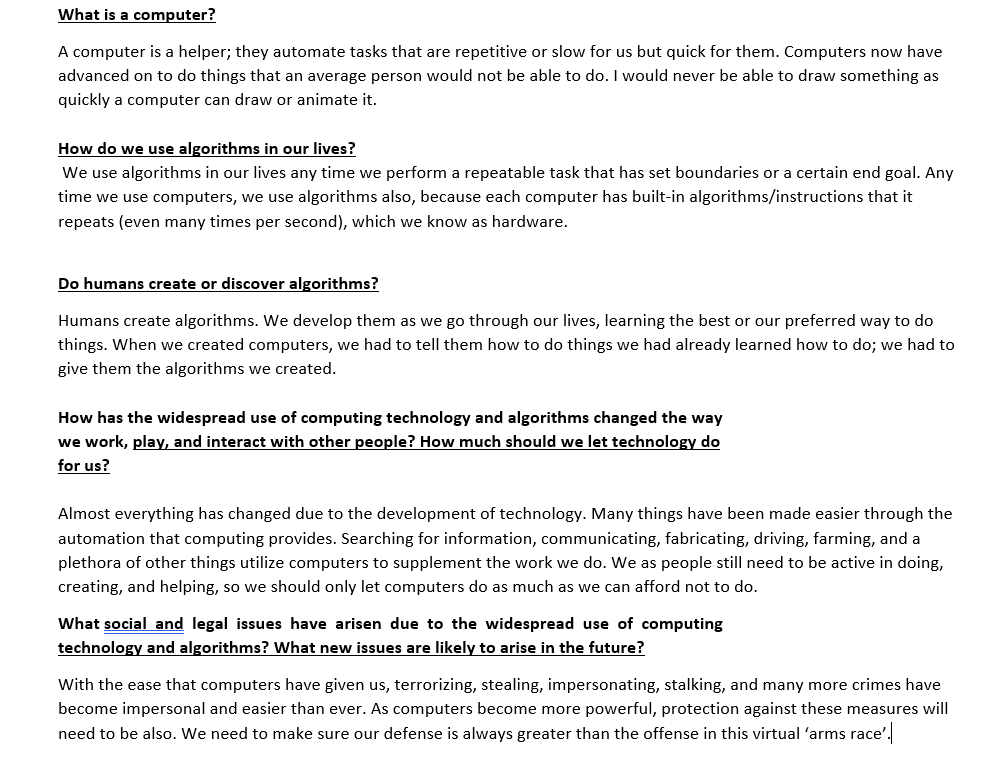
Feona Dabson found it amazing and relaxing to make a song. In the lyrics, she highlights the way algorithms occur outside of the electronic world. The need to be efficient, limitations of memory, benefits of relaxation, strategic efforts, emotional side to our actions, all that jazz. She took this class and put it into a funky tune, stating that "her lyric video is very rudimentary and made to foster laughter."


So, there you have it. nineteen different responses to the same prompt. Leaving an assignment open (as opposed to strictly defined) provides the learner an opportunity to explore their passions, and thus they are likely to engage with the assignment more fully. It also makes the evaluation of the assignment a lot more interesting, since the submissions are not cookie cutters of each other, and I often learn something new as well. Learner-centered teaching for the win.

What interesting assignments have you had? Describe it in a comment below.

Image credits: All images and other media were provided by their creators.

Saturday, May 11, 2024

My reflections after participating in a Disability & Accessibility Faculty Learning Community during 2023-2024


Disability is not a bad word
I’ve been doing my best to be reasonably knowledgeable and aware of all things related to disability and accessibility—especially as it relates to teaching and learning—for well over a decade. I’ve availed myself of many workshops and training events offered by Ball State University (my employer) over the years and have served as a Disability Services Faculty Mentor for the last few years. As such, when a message arrived in my email inbox that a Disability & Accessibility Faculty Learning Community (FLC) was going to be held during academic year 2023-2024, my initial reaction was one of discounting it, thinking I likely was already familiar with what would be discussed.
However, after a bit of reflection, I decided to participate in the FLC based on the premise that there is always something to be learned. I also realized there were likely concepts and ideas that I’d once learned, not used, and subsequently forgotten. Having a “refresher course” didn’t seem like a bad thing to do. I also figured hanging around a bunch of like-minded folks could be interesting. And so, I signed up.

It turns out I was right about learning new things. The very first week the FLC met, I was confronted with the fact that there were protests half a century ago in support of making all things accessible to all people of which I was totally unaware. It turns out my knowledge of the “disability movement” was totally lacking. These protests and sit-ins eventually led to the signing of Section 504 of the Rehabilitation Act of 1973.

During week two, we explored the disability laws, specifically as they apply to higher education, and week three we explored student and parent expectations about disability services in higher education, and how they might be different than they were used to in high school. This was a good review for me, with a few new insights along the way.

Later weeks found us exploring a myriad of other topics, including implementing accommodations, things that can go wrong, how to make course content accessible, and physical aids and resources that are used by students, among many other topics. Again, I knew (or had known) about most all of this, but it was good to be reminded. Our visit to the Accessible Technology Lab was particularly interesting. To see and hear about the actual technology was impactful. 

"Accessibility takes from no one, and gives to everyone." ~ Amy WebbSo, am I leaving the FLC with any significant new knowledge, understanding, or a change of mind or attitude? No, not really. Very little of the content presented during the FLC was new to me. However, it was very good to hear it again and be reminded of what I need to, and can do for learners. Perhaps I'm leaving with a renewed desire to do all I can to help everyone.

One last observation I’ll make is that it is good to have a second person from the CS department who also participated in the FLC. Not to suggest that other faculty in the department aren’t interested in the services/accommodations we could/should provide to our learners, but it is not necessarily a priority for them—at least not enough of one for them to attend training events. To have another department faculty member participate with me means I’m not alone; there are (at least) two of us who are interested enough to put in a bit of extra effort. Perhaps the two of us can start a mini revolution within the department. Stay tuned!

P.S.  Since you’ve read to the end, here’s a little treat. For a (slightly irreverent, but largely accurate) video about the “disability movement,” watch this short Comedy Central Drunk History video about how Judy Heumann fought for people with disabilities. I don’t think you’ll be disappointed, and if you are, I'm sorry I suggested it.

Image credits:

Monday, September 4, 2023

Providing ingredients for learner success

In preparation for a Community of Practice meeting about active learning, our facilitator asked us to read Dr. Dunja Trunk's Faculty Focus post entitled "A Recipe for Student Success." In it, they describe five ingredients needed for learner success, and provide details and examples for each of the five. (I encourage you to take a few brief minutes to read their worthwhile post, if you've not already done so.) The five ingredients are the following.

  1. Clear goals and objectives
  2. Develop effective study habits
  3. Establish effective communication channels
  4. Take care of physical and mental well-being
  5. Embrace continuous learning and growth mindset

This got me thinking

I fully support this list and have nothing to add to it, other than an an obvious addition—acquire domain knowledge and understanding. The post did get me thinking, however. To what extent are we teachers/mentors responsible for enabling a learner to utilize these ingredients? Our response to this question likely determines how we teach. In particular, should we...

  1. Assume the learners know about the ingredients and how to use them?
  2. Tell the learners about the ingredients and how to use them?
  3. Give the ingredients to the learners?
  4. Show the learners how to use the ingredients?
  5. Have the learners use the ingredients?

I'll be developing my response to my questions for the rest of this post. I invite you along for the journey, and will be curious to see if you follow me, or take a different path.

Preparing a meal

If we use an analogy of preparing a meal, it seems to me that an individual is not likely to be (consistently) successful simply by reading and following a recipe, unless they have a lot of past experience doing so. So if our learners have little experience or knowledge, we best avoid assuming they know what's needed for the meal. Further, we can't simply tell them the ingredients they need, as they may not know where to acquire the needed ingredients. Also, telling someone how to put icing on a cake is not likely to lead to success for them  the first time. It takes practice; sometimes lots of practice.

So, perhaps we need to be giving our learners the ingredients, and showing how to use them. How much garlic is enough, but not too much? Does the water need to be cold or warm when we add it to the other ingredients? What part of the meal should we start preparing first, if we want everything ready at (roughly) the same time? Preparing a meal is not easy. Getting it right the first time is quite a challenge. Learning is not easy either, nor is getting it right the first time.

But, simply giving our learners the ingredients and showing them what to do with them still doesn't seem like enough. We need them to actually try (and likely fail) to make the meal themselves. It is in the doing (and failing) that learning happens. The more we do, the more practice we have, the better we get.

But, what about chefs?

But, what if we have a learner who is very experienced, and has a broad understanding of the material? I think I still arrive at the same point as I did before. However, I won't be explaining and demonstrating near as much, and certainly would not expect to be discussing or showing foundational ideas and skills. If I'm working with a "chef" to prepare a meal, it is going to be more of a collaboration—the two of us will be sharing ideas and questioning each other. But there will still likely be some advanced knowledge or skills that they do not yet have, and need to observe and practice. And yes, I'll likely learn something from them as well during that collaboration.

My teaching

How does all this impact how I teach and mentor? I've posted about how I teach a few times, here and here, for example. I strive to develop and repeatedly present clear course goals and objectives to the learners. I provide opportunities for them to develop effective study habits. I do my best to have clear and consistent communication with the learners, and encourage them to do so, as well. I consider the individual learner when making decisions, and I am constantly promoting a growth mindset and reminding the learners that making mistakes is fine, as long as we learn from them.

My teaching heavily utilizes the following.

  • Active learning
    • Flipped learning
    • In-class demonstrations and activities
    • Small group discussions
    • Class discussions
    • In- and out-of-class group work
  • Learner-centered focus
  • Specifications grading, and sometimes ungrading
  • Flexible due dates, based on circumstances
  • Very little lecturing

I strive to provide a learning environment focused on the learner, not me. I strive to be aware of what the learners do and do not know, and meet them where they are. Sometimes I'm able to accomplish this in class, and sometimes it is accomplished in one-to-one sessions in my office or via Zoom. When teaching higher-level courses, I do expect the learners have more experience, but I try not to assume it. That is, I strive to verify what experience they are bringing to the course. 

I strive to always provide examples of, and opportunities for the learners to practice, the five ingredients needed for learner success that Dr. Dunja Trunk described in their post.

Your teaching?

How do my thoughts and approach to teaching/mentoring match up with yours? What can we learn from each other? Please share your thoughts and ideas so that I (and other readers) can benefit from them. I look forward to it, as I continue to learn how to treach.

Image credit: https://stock.adobe.com/

Thursday, August 10, 2023

Teachers need to struggle to learn

The towel was a gift from a student. I take it on all my trips now.
I’ve previously written about the empathy I’ve gained while traveling. In that post, I asked if you remember what it was like to first learn the body of knowledge which ultimately became your profession. I observed that much of the initial content we learned is second nature to us now. We don’t even think about the fact that there was a time when we didn’t know it, and we may have even forgotten how much we struggled to learn that which seems trivial to us now.

I’ve again had an experience that reminded me of the challenges that occur when facing something completely new. As a result, I’ve come to believe that every teacher needs to periodically have a similar experience. Beyond the learning that will occur, it will remind them what it’s like to learn, and make them better teachers. Stay with me for a few minutes, and I’ll explain.

As I write this post, I’m mid-way through an eight-hour airplane flight from Berlin, Germany, to New York, New York. My wife and I are at the end of a nearly three-week vacation in Denmark, Norway, Sweden, and Germany. We’ve previously traveled internationally a few times, but, except for one trip, our destination has been to England, Scotland, and Ireland—all countries where English is very prevalent. English was still fairly common this trip as well, primarily due to us being in tourist areas. None-the-less, we still experienced many challenges.

Our experiences

Visiting these countries meant that we were met with many different languages, and we don’t speak or read any of them. We experienced many different customs as we moved from one country to another. Each country had their own currency, and varying exchange rates with the US dollar. (To make things a bit more confusing, Denmark, Norway, and Sweden all call their currency by the same name, but they are each a unique currency.) Also, living in Muncie, Indiana, and having our own cars, we are not accustomed to traveling by busses and trains. We found that the transportation schedule tables were very confusing and difficult to understand.

Our feelings

As a result of these experiences, we often felt confused, frustrated, isolated, and occasionally, helpless. Not being able to read or communicate with others presented a significant challenge at times. We had to resort to non-verbal approaches. Not knowing local customs, currency, or how to read transportation schedules meant we had to ask questions. But who do you ask, and what do you ask? If you’re an introvert, or like being self-sufficient, reaching out to others can be a real challenge. And it can feel like you’re bothering others when you ask for help to do something that you “should” be able to do on your own—at least you could if you were back home. We must have looked as confused as we were at times, as locals often asked if we needed help.

Look for the helpers

Fortunately, a variety of things helped us work through the challenges and to enjoy our trip. We found resources, both technological and human. Translator programs were a great help for understanding individual words or short phrases. Most local people with whom we interacted were (at least) bi-lingual and seemed accustomed to communicating with us foreigners. Utilizing online maps and directions was a tremendous help. We sometimes had a local guide which was great, in that they could provide “color commentary” that we likely would have otherwise missed. They also were familiar with transportation schedules and venues and helped us experience the most we could in a fixed amount of time.

Aside from those specifics, we found other factors helpful. Consistency and structure were a tremendous help. Once we learned one thing, we could often apply that knowledge to something else that was similar, quickly furthering our learning. And most of all, it simply took patience, practice, time, and a willingness to learn.

Our learners in a “foreign” land

How similar were my recent challenges to those that our learners experience—especially our first-time learners? Students are arriving on campuses as I write this or will be soon. The experiences of those attending college for the first time may be very similar to what I experienced. They must learn to navigate new environments, cultures, expectations, and new-found freedoms. They will discover that earning in college is likely different than high school. Professors may teach in different ways and have different expectations. They will need to reach out for help from their peers and professors.

We can help!

Our learners need help navigating these challenges. We can provide consistency and structure in our courses. We can clearly communicate our expectations. We can be open and approachable so they will feel comfortable asking us for help. We can provide learning opportunities that build on their prior experiences so they have something to which they can relate it. We can reach out to them and offer help.

I needed to struggle!

I already knew this. There is nothing new here; I’ve learned it before. But after a few semesters I started to forget. I needed this vacation to remind me, yet again, what it is like to be a learner—especially a new one. I needed to struggle to understand the language, the schedules, everything. This will make me a better teacher in a few weeks.

What about you?

I firmly believe that all teachers should periodically experience a significant new challenge. Travel to a new country where a language is spoken that you do not know. Learn a new language. Learn a new skill that is unlike anything you already know how to do. Push yourself and expand your horizon. What will you do to become a better teacher?

Sunday, June 11, 2023

Creativity as expressed in HONR 296 final projects (summer/fall 2022 & spring 2023 edition)

I previously wrote about the creative ways learners in my spring 2020, fall 2020, spring and fall 2021 and spring 2022 Honors College courses (HONR 296) exhibited and documented their knowledge and understanding of the course's material. The course title is "Computer Science and Algorithms to Live By." The course final project, in summary, was to create a tangible artifact that recorded their responses to the course’s essential questions, as it related to their chosen major(s) and/or minor(s). In this post, I am showcasing the creativity of nineteen summer 2022, fall 2022, and spring 2023 learners who were willing for me to share their work.

I encourage you to read to the end of this post and click on all the images and links to experience the full breadth of how these students understood computer science and algorithms to impact their current and future lives. In the interest of brevity, I have not provided any commentary about them, but rather have provided a brief description and an image or link for you to investigate further. They are listed in random order.


Samuel Willey connected the course content to his sales major by creating a fictitious company that sells algorithms as a service. He created a commercial that explains why you need to buy algorithms and how useful they are.

Ozzie Kazarian wrote a "choose your own adventure" style click and read story. It attempts to answer course essential questions like "what is a computer" through a sci-fi inspired narrator. It's fairly short to play through; check it out.

Jackson Ketcham created a video that connects the two worlds of computer science and algorithms with the medical field. While using algorithmic analogies, he breaks down the function of medicines (such as antibiotics) and how algorithms will impact the future of medicine. He also uses ASL in the video with drawings to simulate an effective teaching and communicative method of talking with a deaf patient in a hospital.

Jess Melvin combined her anthropology knowledge and fashion skills, to create a "styling bible"—a guidebook for styling gigs—for a fictional client based on the course content. She answered the essential questions abstractly through moodboards and outfit plans and more concretely through text within the guidebook.

Jada Cooper created a group of lessons orchestrated for sixth graders to be introduced to computer science and begin analyzing the importance of these technologies in the world today. The lessons begin with students being given general information and having the freedom to explore more on their own, before wrapping up with a Socratic seminar that dives deeper into these topics and makes connections to our own lives.

Fortune Anjorin created an infographic that explains how technology improves nursing care, as well as the technologies that will be used in the future. She gave examples of the technologies we see nurses use daily at the hospital and did some research on some newly developed robots that will be used in the future.

Liz Davis answered the course's essential questions, and then translated her responses into French, utilizing knowledge from her major. She also delivered her class presentation in French.

Delaney Fritch combined their Political Science and History majors to create an oral history. They interviewed themself, asking the course’s essential questions, and then formally wrote it up as a (fictitious) oral history for the BSU archives.

Joseph Gassensmith created a presentation wherein he explored the course's essential questions as they relate to the practice of law.

Ainsley Hall "rebranded" the course. As the class did a deep dive into algorithms and how they are used in our daily life—especially in the case of social media usage and artificial intelligence—her project focused on introducing and bringing interest to ideas within the course. This rebranding involved creating media pieces (a video, a logo, and social media mockups) and integrating AI speech technology guided by a human-written script to show how newer technologies can be used to assist rather than replace.


Gabrielle Heiser
created a collage that focused on algorithmic bias in healthcare, along with providing responses to how the course's essential question related to nursing.

Kade Wereley-Bross created a visual representation of Broadway attendance numbers throughout the last four decades, in the form of a blanket, based on the classic temperature blanket style yarn project. The colors reflect ranges of attendance numbers. They also provided a document describing how this is related to the course's essential questions.

Dylan Kedra used social work skills to write up a set of patient notes, where a computer was the patient. A representative quote from the notes: "Capability of immense change in the world due to their calculating and intelligent thought processes. While also mentioning their ability to fit into and improve almost every situation when there are clear boundaries set."

Gavin Neal designed a computer slide puzzle game that, once solved, would provide the answers to the course essential questions as the puzzle face. The unpredictability of the puzzle represents how algorithms sometimes are not so easily transferred from one medium to another.


Jess Schroeder created a poster containing images that represented her responses to the course's essential questions.

Abby McElroy practiced writing lesson plans, even if the topic was not at all related to her journalism major. She found making a lesson for computers and algorithms to be a fun twist on things she's been learning to do and included class discussions, homework, and more!


Jentry Keesling created an infographic describing the way computer science has changed psychology and created new fields combining the two.

Max Vale wrote a play about two pieces of brothers learning about what it means to answer the essential questions of the course. It explores where the boundary of human and computer overlap and what happens when that boundary is crossed.

Adrian Tauriainen created a presentation about how computers and technology have impacted the world of architecture.


So, there you have it. Nineteen different responses to the same prompt. Leaving an assignment open (as opposed to strictly defined) provides the learner an opportunity to explore their passions, and thus they are likely to engage with the assignment more fully. It also makes the evaluation of the assignment a lot more interesting, since the submissions are not cookie cutters of each other, and I often learn something new as well. Learner-centered teaching for the win.

What interesting assignments have you had? Describe it in a comment below.

Image credits: All images were provided by their creators.

Saturday, February 4, 2023

There are good people all around you. Recognize them!

A trophy containing the MAC (Mid America Conference) logo, and the words "Outstanding Faculty Award for Student Success." At the bottom, my name is listed, along with 2021-22 and "Ball State University."
The long-awaited MAC trophy!
A year ago, I was named the 2022 Ball State University (BSU) institutional winner of the Mid America Conference (MAC) Outstanding Faculty Award for Student Success. The trophy company the MAC used apparently still had a significant backlog due to COVID supply-chain issues, so the trophy just recently arrived on the BSU campus so it could be presented to me. This post is partially about me, but it's really about all the good people around us, so I encourage you to keep reading.

The MAC Outstanding Faculty Award recognizes one full-time faculty member nominee from each of the twelve MAC institutions that has demonstrated a dedication to student  success. From these nominees one faculty member that has gone above and beyond in their dedication to student success is honored as the winner of the MAC Outstanding Faculty Award for Student Success. That was not me last year, but I was recognized as the BSU institutional winner.

This student-focused award is distinguishable from academic or research-based awards as it celebrates the commitment of the MAC to a holistic student experience and the creation of an environment that supports success in school and in life.

My remarks

A few days ago, BSU held a celebration in my honor at which they presented the trophy to me. What follows are the remarks I made at that event.

This award focuses on student success. So, what actions do I take that I believe contribute to student success? I don’t believe there is any one big thing, but rather lots of little things that all add up to student success. Things like…
    • Using active learning to keep class engaging
    • Using flipped learning by recording videos for learners to watch outside of class, and doing activities in class when they can ask me questions
    • Being learner centered
    • Having learners do reflective writing
    • Being aware of disabilities, and doing what I can to support those learners
    • Doing what I can to keep diversity, equity, and inclusiveness as part of the conversation
    • Using alternative grading, primarily specifications grading, so learners can grow from their mistakes
    • Emphasizing the workforce competencies they are indirectly learning
    • Mentoring immersive learning projects to provide participants a rich learning experience
I make myself very available to learners during class, via email, and in my office (both physically and online) at a variety of hours during the day, since leaners often have questions after 5:00 PM. My goal always is to find a way to help learners understand, learn, and retain the material.

I often tell learners who are regular visitors to my office: “I’ll work at least as hard as you will, to help you learn this material.” What I’m telling them is that if they are trying, I’ll be right there with them—but they must put in some effort.

But this recognition is not fully about me. It’s about all of us in this room, and across campus. I happen to be the one who has a very supportive department chair, Jennifer Coy, who submitted the award nomination that was selected to be the BSU institutional winner last year. But I would not be the faculty member I am today without the interaction, training, guidance, and support of scores of other faculty, staff, administrators, students, and family, all of whom I’ve learned something from over many years. I’ve borrowed tips and techniques from uncounted others, many of whom are in this room today. I firmly believe there are many faculty who are just as deserving—perhaps more so, but are yet to be nominated. I just happen to be the one nominated last year.

I sincerely thank the faculty and students to wrote support letters for me, and everyone who has interacted and shared with me over the years, thus allowing me to learn something from you. I appreciate all of you for taking time out of your day to come to this event.

BSU President Mearns presenting the Outstanding Faculty Award plaque to me.
President Mearns presenting the BSU
Outstanding Faculty Award to me

Good fortune strikes twice!

I also had the good fortune of being nominated by Kara Duquette for the 2022 BSU Outstanding Faculty Award last year. This award is given in recognition of demonstrated composite excellence in teaching, scholarly or creative productivity, and service by a faculty member who has an academic record at Ball State University of more than five years. Eight individual faculty, staff, and administrators from across the breadth of the university took the time to write and submit letters of support for my nomination. Submitted along with the 25-page nomination dossier, Kara and Robbie Mehling produced a four-minute video highlighting why I was being nominated for the award. Ultimately, I was selected from the nomination pool, and was presented the award at Ball State University's fall 2022 faculty convocation. Again, I believe there are many other faculty who are just as deserving—perhaps more so, but are yet to be nominated.

So what!?

So, last year was a good year for me. I received two significant awards within a year's time. I am extremely appreciative of this recognition! While I believe I do a good job, I also suffer a bit from imposter syndrome. I don't see myself as being that good. However, others around me do, and submitted award nominations on my behalf. They saw the worth and merit of being supportive of those around them and chose to expend significant time and effort to recognize someone in whom they believed. To be the recipient of that level of support not once, but twice, is a bit humbling for me.

I ask that you take a look around you. Yes, do it now. Who do you interact with that is doing a good job? Maybe it's as simple as they're doing what they're supposed to do, day in and day out—they're dependable. Let them know that you appreciate them. If their effort, ability, or attitude is rising above others, let them know that you noticed. If there is an award for which you can nominate them, do it. Regardless of being selected as the winner or not, simply being nominated is recognition in itself. 

Letting people know that you appreciate them, support them, and believe they are doing good, will likely be returned to you. I know I'm more inclined to go above and beyond what is needed or expected when I'm feeling appreciated by those around me. How about you?

So, who are you going to recognize this week?


Image credits:
MAC trophy photo by David Largent
BSU award presentation photo by Kara Duquette