Showing posts with label learner-centered teaching. Show all posts

Thursday, July 4, 2024

Creativity as expressed in HONR 176 final projects (summer/fall 2023 & spring 2024 edition)

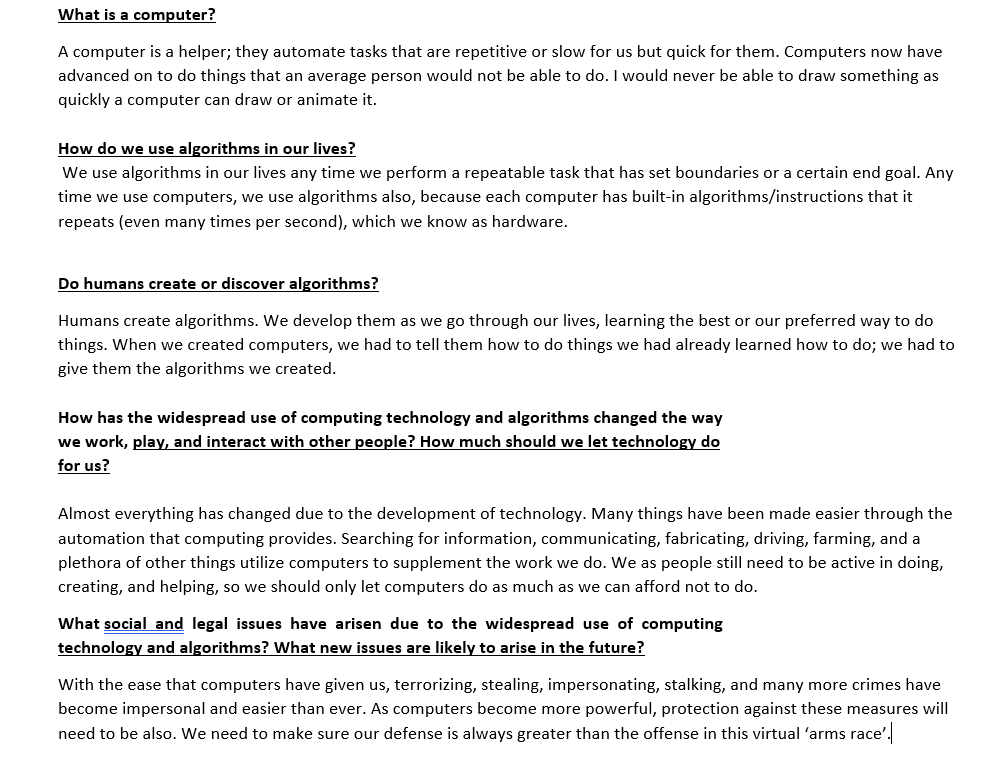
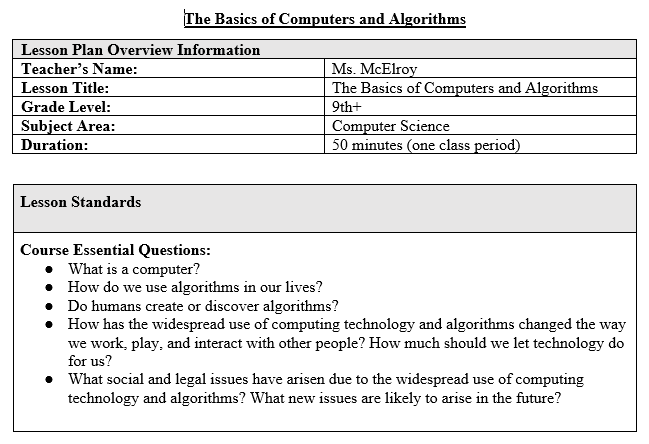
I previously wrote about the creative ways learners in my spring 2020fall 2020spring and fall 2021spring 2022, and summer/fall 2022 and spring 2023 Honors College courses (HONR 296. now HONR 176) exhibited and documented their knowledge and understanding of the course's material. The course title is "Computer Science and Algorithms to Live By." The course final project, in summary, was to create a tangible artifact that recorded their responses to the course’s essential questions, as it related to their chosen major(s) and/or minor(s). In this post, I am showcasing the creativity of nineteen summer 2023, fall 2023, and spring 2024 learners who were willing for me to share their work.

I encourage you to read to the end of this post and click on all the thumbnail images and links to experience the full breadth of how these students understood computer science and algorithms to impact their current and future lives. In the interest of brevity, I have not provided any commentary about them, but rather have provided a brief description and an image or link for you to investigate further. They are listed in random order.


Evan Davis, being an architecture major, created a physical model to connect the ideas of this course to what he learned throughout his first-year studio. This is an example of a study model, which is a 3-D model made using simple materials to help visualize a more complicated idea. Through turning the antenna coming out the top of the computer, the words on the screen shift, revealing answers to all the course's essential questions.

Mang Lian created a slide show that connected architecture to algorithms. It helped him understand what a computer is and how you can see it through architecture as well.
Margaret Manning created a slide show that presented an algorithm of swallowing, and explained how algorithms and computers are related to the job of a speech-language pathologist.
Jenna Mathes created an algorithm that describes the steps needed to diagnose and treat an articulation disorder in a child. This is an extremely long process, but by breaking it down into a multi-step algorithm, she hopes to have simplified it, making it more digestible.

Clara Daugherty created a drawing that was meant to tie in many aspects talked about in class. As a hospitality major, she found it a little difficult but if you sit and look at it long enough, all questions of the course essential questions will be answered.

Abigail Denault, being a journalism major, responded to the course's essential questions in the format of a 12-page booklet, complete with a table of contents and cover.

Amelia Dorsey recorded a video answering questions about how algorithms are related to our lives.
Eli Germain created an infographic that describes ways in which algorithmic thinking can be applied to the strategies of modern board games. It describes four strategies based on algorithms and applies their structures to two popular board games--Catan and Ticket to Ride.
Sarah Olsen wrote a magazine article. In it she stated "Though simple in theory, algorithms and the computers that use them are often far from basic, and while many algorithms are observable in nature, many more are manufactured by humans in order to solve a specific problem."

Megan Pax created a set of art activity and project lesson plans designed for the middle school level that are based on the course's essential question. All components of lesson plans are included, such as objectives, standards, sequences, materials, references, and assessments.

Keegan Fontaine created a brief podcast in which three students discuss the course's essential questions, and how their lives relate to them.
Afton Vanek researched how algorithms will impact the future of art museums, especially with the popularity of artificial intelligence in the 21st century, and presented her responses in the format of an infographic.
Maurianna Manuel created a presentation that compared the widespread use of computer technology to the growing field of nursing and how the two work harmoniously together.

Mar Nester created this video as a crash-course about all of the topics we covered in this course.
Grace Provenzano explored the application of algorithms, math, and technology in an abstract and artistic manner in this video. Using the natural world as inspiration, it analyzes the impact increasing technological advances have made on our daily lives and environment.
Lindsey Thole applied an algorithmic approach to architectural design consisting of a repeating process of extrusion and subdivision.
Brooke Williams drew this picture of a brain, stating that a "brain is a computer that all of us have inside of us."

Lucas Moody  created a remake of a song  called "Can’t Stop Partying" by Weezer ft. Lil Wayne. It wraps up everything that he learned in the course through the lyrics.

Feona Dabson found it amazing and relaxing to make a song. In the lyrics, she highlights the way algorithms occur outside of the electronic world. The need to be efficient, limitations of memory, benefits of relaxation, strategic efforts, emotional side to our actions, all that jazz. She took this class and put it into a funky tune, stating that "her lyric video is very rudimentary and made to foster laughter."


So, there you have it. nineteen different responses to the same prompt. Leaving an assignment open (as opposed to strictly defined) provides the learner an opportunity to explore their passions, and thus they are likely to engage with the assignment more fully. It also makes the evaluation of the assignment a lot more interesting, since the submissions are not cookie cutters of each other, and I often learn something new as well. Learner-centered teaching for the win.

What interesting assignments have you had? Describe it in a comment below.

Image credits: All images and other media were provided by their creators.

Monday, September 4, 2023

Providing ingredients for learner success

In preparation for a Community of Practice meeting about active learning, our facilitator asked us to read Dr. Dunja Trunk's Faculty Focus post entitled "A Recipe for Student Success." In it, they describe five ingredients needed for learner success, and provide details and examples for each of the five. (I encourage you to take a few brief minutes to read their worthwhile post, if you've not already done so.) The five ingredients are the following.

  1. Clear goals and objectives
  2. Develop effective study habits
  3. Establish effective communication channels
  4. Take care of physical and mental well-being
  5. Embrace continuous learning and growth mindset

This got me thinking

I fully support this list and have nothing to add to it, other than an an obvious addition—acquire domain knowledge and understanding. The post did get me thinking, however. To what extent are we teachers/mentors responsible for enabling a learner to utilize these ingredients? Our response to this question likely determines how we teach. In particular, should we...

  1. Assume the learners know about the ingredients and how to use them?
  2. Tell the learners about the ingredients and how to use them?
  3. Give the ingredients to the learners?
  4. Show the learners how to use the ingredients?
  5. Have the learners use the ingredients?

I'll be developing my response to my questions for the rest of this post. I invite you along for the journey, and will be curious to see if you follow me, or take a different path.

Preparing a meal

If we use an analogy of preparing a meal, it seems to me that an individual is not likely to be (consistently) successful simply by reading and following a recipe, unless they have a lot of past experience doing so. So if our learners have little experience or knowledge, we best avoid assuming they know what's needed for the meal. Further, we can't simply tell them the ingredients they need, as they may not know where to acquire the needed ingredients. Also, telling someone how to put icing on a cake is not likely to lead to success for them  the first time. It takes practice; sometimes lots of practice.

So, perhaps we need to be giving our learners the ingredients, and showing how to use them. How much garlic is enough, but not too much? Does the water need to be cold or warm when we add it to the other ingredients? What part of the meal should we start preparing first, if we want everything ready at (roughly) the same time? Preparing a meal is not easy. Getting it right the first time is quite a challenge. Learning is not easy either, nor is getting it right the first time.

But, simply giving our learners the ingredients and showing them what to do with them still doesn't seem like enough. We need them to actually try (and likely fail) to make the meal themselves. It is in the doing (and failing) that learning happens. The more we do, the more practice we have, the better we get.

But, what about chefs?

But, what if we have a learner who is very experienced, and has a broad understanding of the material? I think I still arrive at the same point as I did before. However, I won't be explaining and demonstrating near as much, and certainly would not expect to be discussing or showing foundational ideas and skills. If I'm working with a "chef" to prepare a meal, it is going to be more of a collaboration—the two of us will be sharing ideas and questioning each other. But there will still likely be some advanced knowledge or skills that they do not yet have, and need to observe and practice. And yes, I'll likely learn something from them as well during that collaboration.

My teaching

How does all this impact how I teach and mentor? I've posted about how I teach a few times, here and here, for example. I strive to develop and repeatedly present clear course goals and objectives to the learners. I provide opportunities for them to develop effective study habits. I do my best to have clear and consistent communication with the learners, and encourage them to do so, as well. I consider the individual learner when making decisions, and I am constantly promoting a growth mindset and reminding the learners that making mistakes is fine, as long as we learn from them.

My teaching heavily utilizes the following.

  • Active learning
    • Flipped learning
    • In-class demonstrations and activities
    • Small group discussions
    • Class discussions
    • In- and out-of-class group work
  • Learner-centered focus
  • Specifications grading, and sometimes ungrading
  • Flexible due dates, based on circumstances
  • Very little lecturing

I strive to provide a learning environment focused on the learner, not me. I strive to be aware of what the learners do and do not know, and meet them where they are. Sometimes I'm able to accomplish this in class, and sometimes it is accomplished in one-to-one sessions in my office or via Zoom. When teaching higher-level courses, I do expect the learners have more experience, but I try not to assume it. That is, I strive to verify what experience they are bringing to the course. 

I strive to always provide examples of, and opportunities for the learners to practice, the five ingredients needed for learner success that Dr. Dunja Trunk described in their post.

Your teaching?

How do my thoughts and approach to teaching/mentoring match up with yours? What can we learn from each other? Please share your thoughts and ideas so that I (and other readers) can benefit from them. I look forward to it, as I continue to learn how to treach.

Image credit: https://stock.adobe.com/

Sunday, June 11, 2023

Creativity as expressed in HONR 296 final projects (summer/fall 2022 & spring 2023 edition)

I previously wrote about the creative ways learners in my spring 2020, fall 2020, spring and fall 2021 and spring 2022 Honors College courses (HONR 296) exhibited and documented their knowledge and understanding of the course's material. The course title is "Computer Science and Algorithms to Live By." The course final project, in summary, was to create a tangible artifact that recorded their responses to the course’s essential questions, as it related to their chosen major(s) and/or minor(s). In this post, I am showcasing the creativity of nineteen summer 2022, fall 2022, and spring 2023 learners who were willing for me to share their work.

I encourage you to read to the end of this post and click on all the images and links to experience the full breadth of how these students understood computer science and algorithms to impact their current and future lives. In the interest of brevity, I have not provided any commentary about them, but rather have provided a brief description and an image or link for you to investigate further. They are listed in random order.


Samuel Willey connected the course content to his sales major by creating a fictitious company that sells algorithms as a service. He created a commercial that explains why you need to buy algorithms and how useful they are.

Ozzie Kazarian wrote a "choose your own adventure" style click and read story. It attempts to answer course essential questions like "what is a computer" through a sci-fi inspired narrator. It's fairly short to play through; check it out.

Jackson Ketcham created a video that connects the two worlds of computer science and algorithms with the medical field. While using algorithmic analogies, he breaks down the function of medicines (such as antibiotics) and how algorithms will impact the future of medicine. He also uses ASL in the video with drawings to simulate an effective teaching and communicative method of talking with a deaf patient in a hospital.

Jess Melvin combined her anthropology knowledge and fashion skills, to create a "styling bible"—a guidebook for styling gigs—for a fictional client based on the course content. She answered the essential questions abstractly through moodboards and outfit plans and more concretely through text within the guidebook.

Jada Cooper created a group of lessons orchestrated for sixth graders to be introduced to computer science and begin analyzing the importance of these technologies in the world today. The lessons begin with students being given general information and having the freedom to explore more on their own, before wrapping up with a Socratic seminar that dives deeper into these topics and makes connections to our own lives.

Fortune Anjorin created an infographic that explains how technology improves nursing care, as well as the technologies that will be used in the future. She gave examples of the technologies we see nurses use daily at the hospital and did some research on some newly developed robots that will be used in the future.

Liz Davis answered the course's essential questions, and then translated her responses into French, utilizing knowledge from her major. She also delivered her class presentation in French.

Delaney Fritch combined their Political Science and History majors to create an oral history. They interviewed themself, asking the course’s essential questions, and then formally wrote it up as a (fictitious) oral history for the BSU archives.

Joseph Gassensmith created a presentation wherein he explored the course's essential questions as they relate to the practice of law.

Ainsley Hall "rebranded" the course. As the class did a deep dive into algorithms and how they are used in our daily life—especially in the case of social media usage and artificial intelligence—her project focused on introducing and bringing interest to ideas within the course. This rebranding involved creating media pieces (a video, a logo, and social media mockups) and integrating AI speech technology guided by a human-written script to show how newer technologies can be used to assist rather than replace.


Gabrielle Heiser
created a collage that focused on algorithmic bias in healthcare, along with providing responses to how the course's essential question related to nursing.

Kade Wereley-Bross created a visual representation of Broadway attendance numbers throughout the last four decades, in the form of a blanket, based on the classic temperature blanket style yarn project. The colors reflect ranges of attendance numbers. They also provided a document describing how this is related to the course's essential questions.

Dylan Kedra used social work skills to write up a set of patient notes, where a computer was the patient. A representative quote from the notes: "Capability of immense change in the world due to their calculating and intelligent thought processes. While also mentioning their ability to fit into and improve almost every situation when there are clear boundaries set."

Gavin Neal designed a computer slide puzzle game that, once solved, would provide the answers to the course essential questions as the puzzle face. The unpredictability of the puzzle represents how algorithms sometimes are not so easily transferred from one medium to another.


Jess Schroeder created a poster containing images that represented her responses to the course's essential questions.

Abby McElroy practiced writing lesson plans, even if the topic was not at all related to her journalism major. She found making a lesson for computers and algorithms to be a fun twist on things she's been learning to do and included class discussions, homework, and more!


Jentry Keesling created an infographic describing the way computer science has changed psychology and created new fields combining the two.

Max Vale wrote a play about two pieces of brothers learning about what it means to answer the essential questions of the course. It explores where the boundary of human and computer overlap and what happens when that boundary is crossed.

Adrian Tauriainen created a presentation about how computers and technology have impacted the world of architecture.


So, there you have it. Nineteen different responses to the same prompt. Leaving an assignment open (as opposed to strictly defined) provides the learner an opportunity to explore their passions, and thus they are likely to engage with the assignment more fully. It also makes the evaluation of the assignment a lot more interesting, since the submissions are not cookie cutters of each other, and I often learn something new as well. Learner-centered teaching for the win.

What interesting assignments have you had? Describe it in a comment below.

Image credits: All images were provided by their creators.

Saturday, November 12, 2022

How I teach

Me standing in front of a classroom, gesturing towards a screen.
A photo of me doing what I rarely do--lecturing

I was recently asked about how I teach. Obviously, teaching is something I do daily, and I do give it a fair amount of thought, but I’d never been asked this all-encompassing question before—or at least not for a long time. It got me thinking about how I actually do teach, and how I create a learning environment in which learners can learn.

How do I teach?

The person asking the question offered a few prompts to help focus my thinking. The following are my bullet-point responses to his questions.

What strategies do you use to get and keep students engaged in class?

  • Active learning: What better way is there to learn, other than by doing, and learning from your mistakes while doing?
  • Flipped learning: Let’s apply new knowledge and skills during class, when questions can be asked, and save the lower order of Bloom’s taxonomy for individual learning outside the classroom.
  • Learner-centered teaching: Teaching and learning is about enabling the learner to learn, not about enabling the teacher to teach.
  • iClicker learner response system: This and similar tools provide a great way to provide (anonymous, if desired) responses and feedback in the classroom.
  • Check in surveys throughout the semester: Giving the learners opportunities to reflect on how their learning is progressing during the semester, and what you might be able to do to create a better learning environment can be powerful for both learner and teacher.
  • Reflection papers: Like the check in surveys, creating opportunities for learners to reflect on what and how they are learning is powerful.
  • Specifications grading (and exploring ungrading): Points are not the only way to represent what an individual has learned. I’ll even go further and say they may be a bad way to do so. I’ve found specifications grading to be a much better option and have recently been dabbling with ungrading. I've previously posted about specifications grading.

What strategies do you use to get and keep students engaged in community and to develop an identity within your class? (That is, to encourage engagement in campus life or contact outside class, i.e., studying together.)

  • Pair-programming and group work: Have learners work together on a regular basis in class, and the relationships will inevitably flow to outside of class.
  • Small group discussions: Taking time to share opinions and understanding with others—and listening to their point of view—opens a communication channel.
  • Immersive learning: Learning while doing, and satisfying others needs in the process is a tremendous motivator.
  • Expert of the Day: Asking learners to complete work on their own before class, and then serve as a teaching assistant during class helps reinforce their learning. It also provides multiple opportunities to interact with others.

What strategies do you use to lecture or otherwise deliver course content effectively?  

  • I try to avoid lecturing! I’ve found that talking about a topic for an extended period of time seldom is productive. Learning by listening is not near as productive as learning by doing.
  • Flipped learning: See above.
  • Active learning: See above, again.
  • Discussion (mostly Socratic): For teaching things other than skills, discussion is great—especially if I can avoid stating my personal opinions, but rather provide an environment in which the learners critically think about their own ideas and understanding, share that with others, and learn from others.
  • Disability awareness and accessible Canvas course site: If you have challenges accessing the course site—for any reason—your learning opportunities are going to be diminished. Every learner deserves full access to every learning opportunity.
  • Diversity, equity, and inclusivity: Understanding what others bring to the classroom provides opportunities to reduce or remove barriers to learning, as well as providing rich opportunities for all to learn.

How do you think about course design (syllabus, sequencing, assessment, assignments, activities, etc.)?

  • I think about Understanding By Design (Wiggins & McTighe), but admittedly seldom am successful at fully implementing it due to the time I provide myself. I need to do better.
  • I keep Universal Design for Learning (UDL) in mind: If I do something to help one learner, I likely will help many others.
  • I tie course activities/learning outcomes to workforce competencies (NACE): Beyond content knowledge (which may become obsolete, given time), learners also need to learn and recognize non-domain transferable skills. Anything I can do to establish the relationships between class activities and workforce competencies will be a good thing.
  • I have a very long, but “warm,” supportive, learner-focused syllabus: My approach is to incorporate useful (non course) content into the course syllabus in the hope that the learner will discover some other content while they’re looking for the first thing.
  • Diversity, equity, and inclusivity, and having an accessible Canvas course site: See above.

How do you balance rigor with flexibility?

  1. harsh inflexibility in opinion, temper, or judgment: severity
  2. the quality of being unyielding or inflexible: strictness
  3. severity of life: austerity
  4. an act or instance of strictness, severity, or cruelty
  5. a tremor caused by a chill
  6. a condition that makes life difficult, challenging, or uncomfortable
  7. strict precision: exactness
  8. obsolete: rigidity, stiffness
Based on those definitions, I’m not sure I want rigor. (I’ll admit I don’t have a better word at the moment, however.) Obviously, I do want learners to learn, and want a reliable way to measure that learning.
  • Specifications grading: Beyond what I’ve said above, and elsewhere, Specs grading encourages learners to work on assignments and projects until learning occurs, rather than measuring the learning at one predetermined moment in time. I teach so others can learn, not so that I can assign a grade.
  • Open/flexible assignments: Having flexibility in assignments can provide options to the learner, and greatly reduce the temptation to copy someone else’s work. If your project is different than someone else’s, you can’t do exactly the same thing. You can share ideas and learn from each other, however.

To what extent, and how, do you keep up with discussions in your field about pedagogy?

  • Conferences: I attend and present at as many as I can. Some of my regulars include:
  • Blog and Twitter: I tend to use my blog and social media to be reflective about my academic life and experiences. I also learn from others who do the same thing.
  • Professional development:  I’m very fortunate to have a university that is focused on ensuring every faculty member has an opportunity to be the best they can be. I’ve taken advantage of many of these opportunities.

What are the most common barriers to learning for your students? How do you approach these barriers?

  • Fixed mindset: If you don’t think you can do something, you’re probably right. I fight this by being supportive, encouraging, and affirming. I also strive to dd “yet” to their vocabulary, as in, “I can’t do it yet.”
  • Life gets in the way: Learners often struggle because of “life.” I provide Oops Bits to the learners for them to “spend” when they need to submit something late or miss a class. I’m also flexible with due dates when learners have extreme circumstances occur in their lives.
  • Lack of preparation prior to the course: Sometimes learners come into my class without a specific skill or knowledge. To help these learners, I often offer recurring/scheduled office visits. Depending on their need, I may also refer them to our Learning Center or online resources.
  • Lack of preparation during the course: To encourage learners to continue to prepare for the course all semester, I administer reading quizzes, offer recurring/scheduled office visits, and refer them to our Learning Center or online resources.
  • I tell struggling learners: I will work at least as hard as they do to help them learn the material, thus communicating that they must try, but I will be right there with them.

Let's share and learn

If I were to ask you how you teach, what would be your response? Would it be similar to mine, or completely different? What do you do that works for you and your learners? Please share; let’s learn from each other.

Thursday, June 2, 2022

Creativity as expressed in HONR 296 final projects (spring 2022 edition)

I previously wrote about the creative ways learners in my spring 2020, fall 2020, and spring and fall 2021 Honors College courses (HONR 296) exhibited and documented their knowledge and understanding of the course's material. The course title is "Computer Science and Algorithms to Live By." The course final project, in summary, was to create a tangible artifact that recorded their responses to the course’s essential questions, as it related to their chosen major(s) and/or minor(s). In this post, I am showcasing the creativity of twelve spring 2022 learners who were willing for me to share their work.

I encourage you to read to the end of this post and click on all the images and links to experience the full breadth of how these students understood computer science and algorithms to impact their current and future lives. In the interest of brevity, I have not provided any commentary about them, but rather have provided a brief description and an image or link for you to investigate further.


Kaila Brack developed an info-graphic in which she describes how computing technology and algorithms have completely changed the field of nursing. By answering the essential questions, she discuss how patient care has been improved, as well as some of the downsides to the rapid increase of technology in hospital settings.

Sammy Bredar wrote a children’s book about the advancement of technology in society. The story's introduction reads:

There are three groups of characters in this book, which include the Elders, the Computers, and the Humans. In the book, a handwritten manuscript explains to her grandchildren, who are a typed novel and a printed newspaper, how technology changed her world. The plot of most of the book is the grandmother’s personal account of the history in “The Town” which is full of residents like pencils, pens, papers, and other non-technical objects who live comfortably in their technology-free neighborhood, working each day for the benefit of the Humans.

Lillian Brown wrote a short story which is a modern adaptation of the popular book My Side of the Mountain. It is written as a series of journal entries. She writes as Sam Gribley about his adventures after he runs away to the mountains. The purpose of the adaptation is to show how technology touches every part of our lives and can be both a help and a hindrance.

Hanna Cheek created a crossword puzzle as an interactive way to showcase the relationship between real life experiences in a social work/counseling setting and the content explored throughout this course.

Claire Close created an info-graphic that takes a deeper dive into the connection between algorithms that we use in our daily lives and the field of police work. She suggests that when we work to understand one aspect of policing, a new situation arises, causing us to reevaluate what we've already learned.

Chloe Fields dives into the changes computer software has made on hand drawn animation. Two animations were made; one using paper, pencil, and highlighter and one using the current industry standard for hand drawn animation, Toon Boom Harmony. By comparing these different ways of executing the same form of animation one can see the differences algorithms make on the medium.

Elysa Goldberg wrote an academic-style journal article to address the course's essential questions. In it she wrote: 

Regarding how much we should let technology do for us, it is important to find that balance of communicating through technology or computer-generated resources compared to human-to-human contacts especially when dealing with something as real, vulnerable, and sensitive as our emotions thoughts and feelings. I think if it came down to only working with bots to help with psychological issues, that would really create a sense of disconnect.

Eva Kopsolias wrote an algorithm for successful improvised comedy. Her full algorithm is available, but here is the start of it.

  1. START with one person interacting at a time:
    1. Pick a topic from the following:
      1. An object in the room
      2. A childhood memory
      3. Something that happened or was said that day
    2. Create a story from said topic. Just have fun and let it flow naturally.
    3. Establish the setting or context and leave the response to your partner. DO NOT give context and a punchline in one monologue.

Madeleine Mills-Craig created a presentation about making a book. She stated:

Books are a version of a computer that stores data and allows humans to retrieve and then process it. To make a book, one must have the supplies and must be able to put the book together in sequential order. The process of creating a book affirms the stance that algorithms are created because of all the different techniques used to create a book. Today, the algorithm to make a book is much more complicated than in the past, when pages sewn together could be classified as a book, but today, most books have a cover, title, byline, endpaper, etc.

You can watch a brief video of her making a book.

Rosa Reinhard performed an analysis of anamae. In her presentation she stated:

Throughout this course, one major question that came up was "How much is technology influencing us?" In order to answer this question, I created a computational problem related to the question and within the anime Psycho Pass. To examine this computational problem, a case study of the anime Psycho Pass was done by 1. watching the entire anime through the lens of the five essential questions 2. note anything that was related to the problem through the anime’s setting and character choices, and 3. identify how the anime answers the problem. For a computational problem that asks more of a what if and a should type question rather than a how or what, having an anime whose setting is entirely related to the problem allows for a case study to be performed and analyzed.

Nicholas Stoll wrote a computer program using the Python programming language that provided an interactive way for elementary-aged students to combine technology into a humanities context, as the quiz questions can be easily changed.

Kathleen Welch created an info-graphic that provided a compilation of how the course questions related to her environmental management major.


So, there you have it. Twelve different responses to the same prompt. Leaving an assignment open (as opposed to strictly defined) provides the learner an opportunity to explore their passions, and thus they are likely to engage with the assignment more fully. It also makes the evaluation of the assignment a lot more interesting, since the submissions are not cookie cutters of each other, and I often learn something new as well. Learner-centered teaching for the win.

What interesting assignments have you had? Describe it in a comment below.

Image credits: All images were provided by their creators.

Wednesday, February 23, 2022

Creativity as expressed in HONR 296 final projects (spring and fall 2021 edition)

I previously wrote about the creative ways learners in my spring 2020 and fall 2020 Honors College courses (HONR 296) exhibited and documented their knowledge and understanding of the course's material. The course title is "Computer Science and Algorithms to Live By." The course final project, in summary, was to create a tangible artifact that recorded their responses to the course’s essential questions, as it related to their chosen major(s) and/or minor(s). In this post, I am showcasing the creativity of fourteen spring and fall 2021 learners who were willing for me to share their work.

I encourage you to read to the end of this post and click on all the images and links to experience the full breadth of how these students understood computer science and algorithms to impact their current and future lives. In the interest of brevity, I have not provided any commentary about them, but rather have provided a brief description and an image or link for you to investigate further. They are not listed in any particular order.


Jacee Harwell wrote a children’s book expressing her understanding of algorithms. You may read about Courtney the counselor in this PDF of the book.

Reece Malchow created a model of a hamburger and related it to the course material. She explained in a supporting document:

For my final project, I decided to do a hamburger. I plan on being either an Englishprofessor or a GED instructor when I get older, so I wanted to do something fun associated with English. In elementary, when you learn about how to structure sentences, it’s taught by thinking about the structure of a hamburger. The top bun is the topic sentence, the lettuce, hamburger, cheese, etc is the evidence, and the bottom bun is the conclusion or closing sentence. 

Maddie Barber created an info-graphic describing her responses to the courses’ essential questions as they intersected with accounting.You may view the entire PDF

Susan Fleshman created a poster illustrating how the course material related to exercise science. Her description:

The purpose of this project was to visualize the ways in which physical therapists and their patients can be described as computers. This answers the essential question of "what is a computer", as well as touching on the other essential questions.

Emali Grose is working to convert a vacant building in Warsaw, Indiana into a “live, work, play” style of space. The goal is to create a positive environment for the community to gather at, as well as increase retention of community members.

Blake Chapman used his journalism skills to create a photo illustration of his understanding of the course material. He provided this description of it:

This photo illustration visualizes the most important concepts we discussed throughout the semester including sorting, loops, and game theory. In journalism, photo illustrations are used as descriptive feature images to make stories that involve complex subjects more digestible to readers.
Katelyn Mitchell created a set of presentation slides to convey her understanding of the course material as it relates to criminal justice. In an accompanying essay she wrote:

In criminal justice, professionals respect and uphold values of equal justice under the law, access to justice, honesty, integrity, accountability, public safety, openness, and partnership. Even though criminal justice is considered to be a hands-on field, technology plays an important role. From using 5G networks to communicate across land, air, space, and sea to using digital algorithms to reconstruct faces, technology has made substantial advancements in the field.

Jimmy Stueve developed an algorithm to write trombone music. He collected data from the class, fed that into his algorithm, and produced the music. His description follows:

This project seeks to answer the question, “can a simple algorithm write music?” A simple blues jazz solo was generated and performed. While the solo is surprisingly effective, it does not include a personal element that we expect in quality music.

Maarten Bergsma Recorded a quick-start tutorial video about using Grasshopper 3D. Towards the end of the video he addresses the course's essential questions.

Janardhen Jayavel developed a Python program to create a picture collage made from two separate images. This shows an idea of how photography could be related with computer science.
 
Katie Darlage created an animal caretaker checklist as an example of an algorithm. She structured it to look like a daily to-do list for a zookeeper at a fictional zoo, and she wrote about different events that happened throughout the day in various comments sections, relating those daily events in some way to the course's essential questions. For example, she had this comment on the "Enclosure Cleaning" page:

"I feel so bad for Nessie, cuz she gets startled by the glass scrubbers so easily. The amount of times I’ve seen one scrubbing its way into her field of vision before making her jump and swim off in a flurry… I’m sure she doesn’t enjoy the fact that they move on their own accord, and I don’t quite blame her. But hey, having a little robot scrub the glass instead of one of us spending time doing that is way safer and easier for all parties involved."
This story directly relates to the use of computers, as well as some social issues related to computers, since it discusses a motorized scrubber - a computer utilized for safer and more efficient cleaning - and mentions Nessie's aversion to more independent technology that many people also struggle with right now.

Alex Storz created a video about sun-tracking system for solar panels. She wrote:

Alternative energy sources are becoming critical elements of a sustainable future and are constantly advancing in efficiency and design with new data and technologies. The minor addition orienting motors to PV panels helps to maximize their energy production by up to 30% annually. As PVs and other renewable energy sources are becoming increasingly prevalent forms of architectural accessory, these new technologies allow for dynamic systems that push the boundaries of what facade and aperture can mean.

Justin Koren
created an algorithm to help him better predict the March Madness bracket. He built a data base where of ten years of the March Madness tournament, and then built a simulation that would predict the winners of the brackets. The predictions are based off of their seed, their region, their historical records in the tournament, and how well they played during the current season.
 
Brooke Walter created a lesson plan as well as a game board. The project combines history and computer science together by using a board game. The board game encourages students to act as a computer and use these principles while also using their historical knowledge. Students will be able to look deeper at how computers work through the components of this board game as well as reflect upon what they have learned.


So, there you have it. Fourteen different responses to the same prompt. Leaving an assignment open (as opposed to strictly defined) provides the learner an opportunity to explore their passions, and thus they are likely to engage with the assignment more fully. It also makes the evaluation of the assignment a lot more interesting, since the submissions are not cookie cutters of each other, and I often learn something new as well. Learner-centered teaching for the win.

What interesting assignments have you had? Describe it in a comment below.

Image credits: All images were provided by their creators.