Wednesday, September 30, 2020

The teacher becomes the learner: Paving a strong curricular path and humanizing

Continuing my intentional path to explore what I can learn to become a better teacher in a remote synchronous online learning environment, here's part 2. I am participating in a Faculty Learning Community (FLC) sponsored by the Division of Online and Strategic Learning of Ball State University. I will periodically post my reflections in this blog to document my progress, and to serve as a resource for a future me, as I come back to review these posts. Perhaps there will be something of use for other readers that aren't me.

Module 2: Paving a strong curricular path and humanizing

This module focused on paving a strong curricular path and humanizing yourself and the course. The following notes summarize what I gleaned from the module.

Paving the path...

  • Failure is good provided you take the time to embrace and learn from it
    • This needs to be conveyed to learners as well
  • Communication is essential
    • Do so regularly and consistently
    • Communicate expectations and due dates, etc.
    • Must be clear
  • Community building is critical
    • A potential benefit of teaching synchronously online has been my ability to use Zoom’s breakout room random assignment feature. This has forced learners to meet and interact with many more learners in the class than they might have otherwise. if I had them form small groups in an on-campus class, they likely would just interact with those sitting around them, and since they generally sit in the same place every time, that’s the same learners.

Humanizing...

I've discovered in this module that I already do a lot of things to help humanize myself and the course. Here's a brief list of many of those activities.

  • Welcome video: For some courses I’ve created an introductory video of myself and the course and made it available in Canvas.
  • Introductions: During the first week of the semester, I ask the learners to each tell us a couple things about themselves, and then end that activity by allowing the learners to ask me anything they want, and commit to answering (virtually) all of them.
  • Learner choice: In virtually all of my courses, I give learners choice. During the first week of the semester, I always allow them to help set some of the course evaluation criteria by which their final course grade will be determined. As often as I can, I allow the learners to make choices between possible assignments, or how to express their submission for an assignment.
  •  Collaboration: I often provide opportunities for collaboration between learners, either in class or as outside of class assignments.
  • Clear expectations: I’ve been using Specifications Grading for a few years. To do this well, I have to be very clear about the specifications, that is, what I expect of them for a given assignment.
  • Instructional videos: I’ve created many short instructional videos for some of my course, and always include a video of myself in the corner, when capturing the screen.
  • Breakout rooms: I’ve used breakout rooms in my synchronous remote sessions to facilitate small group discussions. Especially during the start of the semester, I randomly assigned learners to the room, and encouraged them to use the first minute of their discussion time for introductions, so they’d start to meet people in class.
  • Music: For years, I’ve played music which I enjoy (AKA primarily from 1960s-1980s) while the learners gather at the start of class, and have continued this in my Zoom-based classes. Every semester, I receive a few comments from the learners that they really like the music, and that I’ve introduced them to a group of which they were not aware.
  • Department video: This summer, I facilitated and produced a “welcome back” video for the department, featuring most of the department faculty. A link to the video was emailed, along with a welcome (back) message,  to all new and returning department majors and minors the week before classes started this fall. If you'd like to watch the video, you may.

Summary

Overall, this was a rather reassuring module for me. It helped me realize I am already doing a lot of things right, and don't need to make any drastic changes in this area.

Wednesday, September 9, 2020

The teacher becomes the learner: part 1

On August 12 of this year, I embarked on an intentional path to explore what I can learn to become a better teacher in a remote synchronous online learning environment. I am participating in a Faculty Learning Community (FLC) sponsored by the Division of Online and Strategic Learning of Ball State University. I will periodically post my reflections in this blog to document my progress, and to serve as a resource for a future me, as I come back to review these posts. Perhaps there will be something of use for other readers that aren't me.

This FLC is a semester-long professional development opportunity that consists of a series of modules containing readings, worksheets, and reflections to help us understand and focus on the best practices to remotely teach online in a synchronous fashion. Every three weeks, we meet (synchronously online--how appropriate!) as a cohort of thirteen learners, mentored by three facilitators. In between meetings, we are to complete the readings and activities in a module.

Module 1: Why synchronous learning?

The first module focused our attention on why we'd want to consider synchronous learning, and things to consider when starting a semester. The following notes summarize what I gleaned from the module.

Key things I need to consider

  • Send a message to learners before each class (or maybe each week) setting expectations and letting them know what they'll be doing
  • Building community is critical

Affirmation of what I already do

  • Having used Flipped Learning for many years, I was encouraged to see it suggested, which opens the door for active learning during the synchronous learning classes

I feel good about

  • Creating/sharing meeting info w/ learners
  • Reminding learners and myself about the upcoming class
  • Basic to moderate features of Zoom/WebEx
  • Tech needs: camera, etc.
  • Technical use of breakout rooms
  • My flexibility

I'm not sure/worried about

  • Not worried, per se, but need to constantly remind myself about accessibility challenges
  • Advanced features of Zoom/WebEx
  • Effective use of breakout rooms
  • Tech issues the students will have

Welcome letter

I prepared a welcome letter for each class explaining my remote synchronous modality, and how I envision synchronous learning in the course. I also drafted a student survey to go along with your letter. The letter was substantially the same as what I've been using for many semesters, with the addition of the following.

This semester, the course will be conducted synchronously online. This means we’ll meet as a class online, using the Zoom platform, at specific times and days. You are expected to attend each of these class sessions, just the same as if class were being held in a campus classroom.

The survey sought to uncover challenges the learner might have with remote synchronous learning, in particular, focusing on technology-related issues. Due to my poor time-management, I did not implement the survey this semester.

Summary

Overall, nothing monstrous appears to be looming on the horizon. I do need to pay attention to technology and access issues for students, and continue to explore how best to utilize the time I will have with the learners in each course, but the latter is no different than normal.

Wednesday, July 29, 2020

Assumed: 1 plus 1 is 2

White question mark on a black background
What assumptions do we make on a regular basis? Should we question those assumptions? If we learn a fact, can we assume it will always be true, or should we re-validate it at some point? Let’s explore these questions a bit by considering some examples.

Some things we learn early in our life journeys that often appear to be facts; once we learn them, it seams reasonable to assume they will always be true. For example, 1 plus 1 gives us 2, and the sun will rise each morning and set each evening, regardless of whether we’re able to see it or not throughout the day.

The sun does appear to rise and set every day, and we understand that to be true due to the rotation of the earth, and its orbit around our sun. There may be clouds that prohibit us from seeing it, but it does rise, nonetheless and brings with it daylight, which goes away when it sets. That is a fact. There's no need to question it, right? As long as the earth continues to rotate and orbit the sun, the sun is going to rise and set each day. But is this a Midwestern US viewpoint. Would someone living on the Arctic Circle make the same assumption? Or might they assume it will rise and set most days, but that there are times when they assume the sun will never rise, and other times it will never set—daylight never arrives, or leaves? Maybe perspective has something to do with the accuracy of assumptions.

Recently, I had an opportunity to interact with an unsophisticated chatbot program, and the conversation started out like this. (My responses to the chatbot are shown in italics.)
Enter your name:  Dave
Hi, Dave! I am Francie. I love studying about women in tech because they inspire me!
Year you were born: 1957
Did you know that Intel built the first microprocessor in 1971?
It happened -14 year(s) before you were born!
Negative 14 years before I was born?!?  Did the chatbot author assume users of their program would be born after 1972? Seems like they ignored nearly half of the population. Maybe knowing our audience has something to do with the accuracy of assumptions.

A decade ago, when I started teaching at the university level, all I knew to do was lecture, so that’s what I did. That is all I had experienced in my many years of undergraduate and graduate courses, and I assumed that is what university teachers did. I assumed it must be the best way for students to learn, because if there was a better way, professors would use that approach, rather than lecture. After teaching a semester or two, I started adding some activities to my class time, and discovered that students responded well to them, and seemed to better learn the material. That started me down a path to discover active learning and the flipped learning environment, and I’ve never gone back to lecturing.

Similarly, all grading I’d experienced had been point based, so I had assumed that was the best (and maybe only) way of tracking and establishing grades. A few years ago, a fellow faculty member introduced me to specifications grading. After trying it in a course one semester, then two courses the next, I’ve been using specifications grading in all of the courses I have taught since that time. Using points to determine grades no longer adds up for me. (Previous posts about specifications grading s are here and here.)

I recently tweeted the following, which perhaps gives some insight as to why many teachers don't change.
I was recently accused of being a boat rocker, based on the following quote from Stephen Brookfield’s "Becoming a Critically Reflective Teacher". I'm taking it as a good thing.
"Teachers who are seen to be reinventing themselves and their practice can commit cultural suicide without even being aware that it is happening. As they speak about how they’re questioning and reevaluating their practice or how they’re doing things differently, they run a real risk that colleagues will see them as engaged in an act of betrayal. They are whistle-blowers on the culture of stasis—the collective agreement not to rock the boat by asking awkward questions or doing things differently."
Maybe past experiences help develop assumptions, but there is a real need to consider altering those assumptions based on new experiences and knowledge.

And in case you’re wondering why I’d question the assumption that 1 plus 1 will always give us 2, you made an assumption, and likely were not even aware if it. You assumed that the math being discussed was being performed in an integer base greater than 2. Obviously (at least for us computer people), the correct answer to 1 plus 1 could be 10, if we’re performing the math in base 2, rather than base 10. Both 2 and 10 are valid answers, depending on the base being used.

What assumptions have you made in the last day, week, or year that perhaps you should have questioned, or sought clarification? Did you know what “base” you were supposed to be using, or should you have confirmed that before spending time and effort, and then having a disagreement with someone who arrived at a different answer because they were using a different base? Was it you who were “off base”, or them—or both of you? Maybe context has something to do with the accuracy of assumptions.

Have I titled this blog post incorrectly? Is this a better title?
Assumed: We should always be willing to check our assumptions and seek clarification, because 1 plus 1 is not always 2.
Based on these examples, it appears that perspective, our audience, past and current experiences, and context are all helpful ways for us to check the validity of our assumptions. Or have I made a wrong assumption?

Image credit: http://www.publicdomainpictures.net

Saturday, July 4, 2020

Creativity as expressed in HONR 296 final projects (spring 2020 edition)

Back in March, I wrote about the 68 ways learners in my Honors College course shared as ways to exhibit and document knowledge and understanding. I also described the course final project, which, in summary, was to create a tangible artifact that recorded their responses to the course’s essential questions, as it related to their chosen major(s) and/or minor(s).

The learners ended up creating visual art (2), making bread, creating collages (2), writing computer programs (2), doing a demonstration, writing an essay or report (2), creating a GIS map, creating infographics (2), writing a journal article, creating music (2), recording a podcast, writing poems, creating a poster, developing a PowerPoint presentation (2), and recording videos (2). I asked all of the students if they were willing for me to share their work. Eighteen of them responded positively, and the rest of this post is devoted to showcasing what they produced.

I encourage you to read to the end of this post, and click on all the images and links to experience the full breadth of how these students understood computer science and algorithms to impact their current and future lives. In the interest of brevity, I have not provided any commentary on them, but rather have provided a very brief description and an image or link for you to investigate further. They are not listed in any particular order.

Dan Council (left) created a GIS map of the US (along with a report), showing the correlation between education level and internet access.

Julia Steele wrote and recorded an informative podcast about her experience with computer science and algorithms, which you can listen to here.

Michaela Cox (right) created an infographic providing a variety of statistics and information about how algorithms impact us daily, ending with "continue saved game?"

Ally Swank (left) created a piece of art using nails and yarn to produce an image of a manta ray. She provided a report which described how the art represented a computer system, our inter-connectedness, algorithms, and the use of computing technology in marine biology research.

Eliza Roark (right) created a series of drawings and then used a program to convert them into ASCII art. Shown here is her drawing of Katherine Johnson of NASA fame.

Kurtis Stuckey explored the differences between live and computer generated music by writing a brief piece of music, playing it himself, and then having a computer play the same music. He recorded a video demonstrating this, along with a bit of commentary.

Ben Eger (left) wrote a simple Python program to display ASCII art and respond to the course essential questions. A brief snippet of code and sample output from the program are provided.

Nick Burrell wrote a report wherein he responded to the course essential questions. He ended with the observation that computer scientists "might be facing job insecurity in a decade or two as we develop more and more algorithms that are supposed to be self-learning. These algorithms could one day potentially write code that is so similar to human code that companies could just use these new algorithms to write programs for customers and cut out the original coders in the process."

Tauri Hagemann wrote a set of poems to address the course essential questions. Here is one of them.
we praise technology for the services it provides,
easier access, easier operation, easier life.
humans are so focused on progress,
there’s no thought of the consequence.

remote learning makes professors more available,
allows things to go on as normal amidst crisis.
except for the student who’s paying through scholarships and loans,
who can’t afford his own computer or laptop
and who doesn’t have internet at home.
he doesn’t know how he’s going to do schoolwork now.
he fears for his future and how he’ll keep up.

social media helps us stay in touch over time and distance.
but we think not of the girl who stands in her room,
crying to herself while she stares daggers at the mirror,
pinching at her stomach even though she hasn’t eaten in days.
she starves herself and curses her reflection because
she doesn’t look like the girls on her Instagram feed.

self-driving cars make travel faster and easier,
except when something goes wrong.
if they crash, who is at fault?
the passenger? the car dealer? the manufacturers?
either way, an accident has killed someone.

we praise technology for the services it provides,
but we give no thought to the consequence.

Ben Smith wrote out his responses to the course essential questions, and then took those words and fed them into an algorithm he developed which converted them into music. A portion of the music score and audio resulting from his efforts is available. After you click on the link, click on the small triangle play button in the top left of the page to listen to his creation.

Lauren Andrews (left) created a poster relating various computer science concepts to the human body. You can view a portion of her report and poster, where she discusses caching, in the provided image.

Drew Thomas (right) created a PowerPoint presentation titled "Coding for non-programmers" wherein he described in simple terms what he does as a computer scientists. A sample slide is provided.

Emma Staicer
(left) created a collage to visually represent how business analytics and the course essential questions relate to everyday life. The background, person with hypnosis glasses, phone, things swirling out of the person’s head, and the  hand reaching for the person all represent different aspects of this relationship.

Genevieve Risner (right) baked bread. She observed that Amish friendship bread starter could be used in a variety of recipes, and it made her think that it could be a computer. The code would be the recipe itself and the variety of ingredients added would be its data. An example of a successful algorithm is shown. There were a couple of less than successful attempts that needed further debugging.

Autumn Auxier provided responses to the course essential questions in the form of a scientific journal article. The opening paragraph of the discussion section is provided here.
I am coming out of this class better understanding more about myself, my career, and life than I ever would have expected in a computer science course. Because I took this class, I have a better understanding of my own career in biology and I can answer the four essential questions of this class in reference to my career. Because most of my career has been dedicated to learning how to write scientifically, I chose to write this paper in the format that I would a scientific article as part of relating this class to my major. Further, because I have focused much of my academic career on research, I have been able to apply what I have learned about computer science to how I will continue to use it in my career as a researcher, no matter where or what I might be researching.
Chloe Wineinger created a compilation of SpongeBob SquarePants video clips in response to the course essential questions. I didn't know cartoons could be so educational. You can watch her compilation here.

Lexy Scheele (left) created a collage in response to the course essential questions. The brains, chickens, girl, black and white graphic, buildings, watch, and car all symbolize different parts of her response.

Jonathan Le (right) created visual organizers describing how video entertainment tropes work by using algorithms to simplify many aspects of our life for maximum effectiveness and efficiency, even when it is considered to be an art form as compared to a practice that follows a rigid logic structure. His organizer for the algorithm for the progression of weapon effectiveness is provided here.

So, there you have it. Eighteen different responses to the same prompt. Leaving an assignment open (as opposed to strictly defined)  provides the learner an opportunity to explore their passions, and thus they are likely to more fully engage with the assignment. It also makes the evaluation of the assignment a lot more interesting, since they are not cookie cutters of each other. Learner-centered teaching for the win.

What interesting assignments have you had? Describe it in a comment below.

Image credits:All images were provided by their creators.

Sunday, April 19, 2020

Of lemons and lemonade on Friday, the 13th of March, 2020

[I started writing this post on Friday, March 13, 2020. It took me more than a month to get back to finishing it.]
 
It's been a weird day. 

No, actually, it's been a weird week. 

I sat in my office until 8:00 tonight, not interested in going home, but not sure why I wanted to stay. I was busy doing something, but not really being productive at anything. I felt a bit numb, but wasn't sure why.

Eventually, I did go home and started reflecting on the events of the last week or so. Perhaps they would shed some light on the weirdness I was feeling.

😊😟😕😞 I had a workshop I was leading at SIGCSE Technical Symposium in Portland, OR during March 11-14. I had been looking forward to attending for months. But with the Coronavirus disease (COVID-19) Pandemic looming, there were questions if I should attend, or if the conference would actually be held. Ultimately, I decided I would attend the conference, and flew to Portland Tuesday evening, March 10, arriving late that evening. I attended two preconference workshops Wednesday afternoon and evening, one via the web. The opening keynote was scheduled for Thursday at 8:15 AM. I received an email at 7:14 AM stating the conference was cancelled due to the Oregon governor mandating late the evening before that all gatherings of more than 250 people were banned. I was up and dressed and ready to head to the conference, but now it was time to reschedule my flight home, pack, and get to the airport. I was successful, and arrived home in the wee hours of Friday morning.

😟😕😞 While I was in Portland, I received word that all classes at Ball State University were going to transition to online due to the Pandemic, effective Monday, March 16. My first reaction was that I had some work to do in the next couple of days to be ready for that when I returned home from the conference. I then realized that when I physically met with students prior to flying to SIGCSE was likely going to be the last time this semester. I was a bit sad at that prospect. But then when the conference was cancelled, and I was able to get a flight back, I was able to meet with three of my four classes on Friday, March 13. Life was a bit better.


😊 I wore my yellow smiley-face tie on Friday in an attempt to spread a bit of cheer to my self, if not others. As I was leaving my house, I happened to think about the making lemons into lemonade proverbial phrase. That prompted me to stop at the store on my way to campus and buy some lemonade mix and cookies to share with the classes I was meeting with that day. The picture above is a result of that. It was appreciated by the students and some staff as well. Even though there were a lot of students missing, it was good to meet with the ones who attended one last time in person.

😊 Good news also arrived while I was in Portland. I was notified that a three-year internal Provost Immersive Learning grant proposal I submitted was being funded. This grant will allow me to continue for another three years the CS4MS+ immersive learning project I started three years ago. It is working with local schools to help them incorporate more computer science and problem solving topics into their curriculum by working with schools administration, teachers, and their students.

😕 As of this Friday, March 13, there was little information about how long we would be conducting emergency remote learning. It was known that it would be for at least two weeks, but could well extend to the end of the semester. Uncertainty often leads to fear and frustration. I can't say I got to that point, but it would have been nice to know for sure what to expect. The situation simply did not allow for that level of knowledge, however.

😟 My wife had been out of town for two weeks, caring for her parents. Her father was having some medical issues that resulted in him being in the hospital for an extended stay. He was usually the one to watch after her mother, who has dementia. With her father in the hospital, my wife took on that role, while also attending to his needs. She hoped to be able to return home soon, but the exact date was uncertain.

😕 So there I sat in my campus office at the end of a long day that had seen me arrive home around 2:00 that morning, after eleven hours of travel. I slept a few hours, then got up in time to be on campus by 9:00 for a 90-minute Zoom meeting with colleagues. I had taught three face-to-face classes one last time that afternoon, sharing lemonade and cookies with the students who were able to be present. I had projects which badly needed evaluating. Not only did I have classes to prepare for the next week, but I needed to figure out how I was going to transition them to emergency remote learning, yet continue the learning process and keep the students engaged.

😕😟 And then the flood of questions started piling up. What tools was I going to use to transition the classes? Would I use asynchronous or synchronous learning, or some combination? How would I administer an exam which was usually administered on paper? Would the students have access to adequate internet bandwidth to participate? What other challenges might the students experience that could interfere with their learning? What could I do to keep them engaged? What could I do to help with their personal circumstances? When was my wife going to be able to return home? How, if at all, will I report on my vita the conference workshop that was accepted to be delivered, but was not delivered, due to the conference cancellation? Would my university reimburse me for expenses I incurred to attend a conference that basically did not happen? How long would we be doing emergency remote learning? Would we be back in the classroom by the end of the semester? Will the Pandemic spare my family and friends?

😕 And so, I sat in my office for five hours after I had met with my last class. Why did I stay? Why did I not go home? No one was expecting me to arrive at home at a particular time, since my wife was out of town. If I stayed in my office, I had the affordances of two large monitors to evaluate projects and prepare for classes the next week. I couldn't focus enough to do either task justice though. Nor was I excited about doing either task. Yet, I didn't want to leave my office. There was no one at home to interact with, so why not just stay in my office and try to get some work done? Was my office somehow comforting me? Was it providing a sense of normalcy amidst the weirdness I was experiencing? 

😕 I eventually convinced myself that 8:00 PM was late enough, and forced myself to head home. I changed my Facebook and Twitter cover photos to the picture on the left to remind me of the classroom in which I often teach. I also left the picture to the right on my office door.

😕😊 Upon arrival home, I ate a bit of supper, and started writing this post. I fell asleep part way through. The next morning provided the good news that my wife's father was doing well enough to care for himself and her mother, and that my wife would be home that afternoon. It was also a new day after a good night's sleep. Time to get busy on the tasks at hand. I had student projects to evaluate and classes to plan for Monday. It was time to get my desk set up for working from home. And my wife was coming home after two weeks' absence. This had to be a good day.

As evidenced by the variety of emoticons prefacing each paragraph above, there were a lot of emotions I experienced this week in March. Some were up, some were down, and some in some unknown direction. Life also became busy, and I never quite completed this post--until now.

So, how's your week been? Was your experience similar a month ago, or since?

Monday, March 2, 2020

Exhibiting and documenting knowledge and understanding: spring 2020 edition

Word cloudI'm currently teaching an Honors College (HC) course this semester which I first taught last semester. Similar to another HC course I taught during fall 2018, I am utilizing a final project rather than a final exam in this new course. As before, I did not define exactly what they were to do for the final project, at least not in terms of structure or format.

I'm providing the students freedom to demonstrate their accumulated knowledge using whatever approach they chose, as long as they can justify it to me. To get them "thinking outside the box," last week during class I asked the students to form small groups and create a list of all of the possible ways they could imagine which could be used to exhibit and document knowledge and understanding. Each group then reported back to the class, with a group member recording their ideas on the white board. Shown in the pictures to the right are a couple of the lists that generated 68 unique ideas they thought of this semester. This far exceeds the 47 my fall 2018 students thought of, and more than doubles the 30 ideas students in the same course came up with last semester.

As before, I was impressed (and sometimes humored and curious) by the breadth and depth of the ideas the students collectively generated. After we reviewed the lists, I gave them the final project specifications, which are:
Final project: A tangible artifact that records your responses to the course’s essential questions, as it relates to your chosen major(s) and/or minor(s). This will be submitted in two draft iterations, with a third final submission. A brief in-class presentation is also expected.

And our essential questions are:

  • What is a computer?
  • How do we use algorithms in our lives?
  • How has the widespread use of computing technology and algorithms changed the way we work, play, and interact with other people? How much should we let technology do for us?
  • What social and legal issues have arisen due to the widespread use of computing technology and algorithms? What new issues are likely to arise in the future?
I could have simply required every student to write a paper and do a presentation. By being learner-centered and allowing each student to determine how they want to exhibit and document their learning during the course, the class and I will be exposed to a wonderful variety of presentations at the end of the semester. My prior experience also suggests that most students will take more ownership of their project than they likely would have of a paper. My firm belief is that if you give your students choice, and they will usually pleasantly surprise you with what they can do.

Having done this activity three semesters, I was curious how the lists compared to each other, so I did a bit of analysis on the respective word lists. After standardizing word forms, etc, I ended up with a combined list of 108 unique words/phrases from the three semesters, including the nearly 70  from this semester. Eight words (7% of the list) showed up on all three semesters' lists.
  • book
  • dance
  • debate
  • game
  • interview
  • test
  • theater
  • write

Twenty more (19%) showed up two of the semesters: art, blog, brain scan, change, connection, demonstrate, experiment, explain, fashion, interpret, Kahoot!, meme, model, perform, poetry, present, reflect, song, teach, and website. The remaining eighty words/phrases (74%) were unique to one semester. The word cloud at the top of this post provides a visualization of the 108 words, with the size of a word indicating how many semesters that word was reported.

How do you prefer to exhibit and document your knowledge? How creative would you have been? Leave your response in the comments below.


Image credits:
Word cloud created with https://www.jasondavies.com/wordcloud/

Saturday, February 8, 2020

Of plants and students; a community conversation in the stairway


Clay pot with small plant

Clay pot with small plant, sitting on a windowsill Grab yourself a cup of tea or hot chocolate, or coffee, if you insist. Find a comfortable seat and settle in. You’re about to read an epic, allegorical story of a plant and students. 

Rupert, 

the red pepper plant

It all started on a warm day back in May 2019. As I often do, that day I walked up the stairs from my office on the third floor of the Robert Bell Building at Ball State University to the Computer Science department office which is located on the fourth floor. As I got to the top of the stairs, I discovered a small clay pot with an even smaller plant in it sitting on the windowsill. Read on to find out what became of the plant, and what that has to do with students.
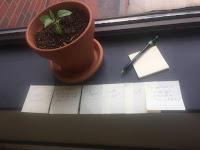
Clay pot with small plant, sitting on a windowsillRupert's birth

Not having any idea why there was a plant on the windowsill, or who placed it there, I decided to start a conversation via sticky-notes. I wrote a message and stuck it on the windowsill in front of the pot, and left a pad of sticky-notes and a pen laying on the windowsill. I soon had a response, so I continued the conversation, a transcription of which follows.
Me (M): Hello little plant. What are you going to be when you grow up?
Response (R): Big pepper.
M: What color?
R: Red!
M: Do you have a name you prefer to be called by?
R: Rupert!
M: Interesting name. Is there a story behind it?
R: Yes.

At this point, a third person (P) entered the conversation, providing what turned out to be rather prophetic advice. I’ve simply labeled the posts from all others as (P) from here on out.
P: Grow little plant grow!! Stay healthy.

Intrigued and amused by the exchange thus far, I continued the conversation.
M: What is the story?
R: I know a dog named Rupert (signed Rose, 7)
M: Rupert, is someone giving you the water you need?
R: Yes! I am being taken care of! Thank you for asking though!
Sticky note next to a dead insect

Rupert's early life

By now, it’s June, and a few others entered the conversation. (The chronological sequence of these messages is not likely as listed.)
P: Dear Rupert, we are so happy you are growing. Enjoy the dead bug next to you.
P: You are a light in darkness.
P: I C U R still hangin in there Rupert!!
P: Plant a seed. Watch it grow by watering it and the sun from God up above. Plant called Lyfe, pronounced Life.
M: Rupert, congrats on your new leaves!
P: Grow for me!
M: I See you’ve grown a couple more leaves since I saw you last week!
P: Rupert hopes to grow up to be Seymore. Hopes to see everyone then.
P: I hope it’s not Audrey II.
P: Happy first day of summer, Rupert/Seymore!
Clay pot with small plant

Rupert made it through the excitement of Independence Day, and now had quite a few leaves. Lots of new messages had been left as well. A few of which were dated.
P: Rupert! You look lovely!
P: I hope you grow well.
P: Atta boi Rupert! I have no idea what you are but I’m excited to see you grow.
P: You’re my hero!
P: Rupert, you can do this! (Don’t die!)
P: Good to see you’re still with us Rupert!
P: Share the love!
P: Your pot needs rotated x1 per day or you will grow lopsided.
M: Rupert! It looks like you got thirsty. (07/16/2019)
P: One must imagine Sisyphus smiling.
P: Go plant go!
P: Be happy little plant.
P: Rupert, where do you see yourself in 5 years?
M: Rupert! It looks like you got thirsty. (07/26/2019)
P: Rupert, I love you and would die for you. You’re doing amazing buddy. Keep growing. (08/27/2019)

Clay pot with dead plantRupert's demise

But then tragedy strikes during September 25-26, 2019.
P: WATER YOUR PLANT.
P: This bug has more life than me.
P: [F]
P: RIP
P: Why is the bug literally me?
P: We should take a lesson from this plant and realize that our relations need love and nurturing to grow!
P: RIP friend.
P: NO!
P: Poor plant.
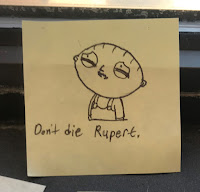
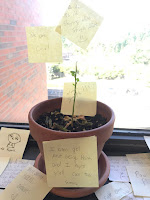
Sticky note that says "Don't die, Rupert"Clay pot with dead plant coming back to lifeRupert's resurrection

 For whatever reason, no one chose to remove the leafless body of Rupert or the notes that had been left. And then suddenly—eight days later—there was new growth!
M: New growth!!!
P: I can get past being thirsty and I hope y’all can too.
P: You’re doing great sweetie!
P: We are cool.
P: Ah, ah, ah, ah, staying alive, staying alive.

Clay pot with plant and a red pepperRupert gives birth?!?

So then my Mom and I decided to have a bit of fun. She provided me one of the red peppers she had grown in her garden, and I left it in the pot with a note on it.
M: So, this pepper showed up last night. I asked Rupert if it was his, but he wouldn’t respond, other than to say he hopes someone will take it and enjoy it. (10/07/2019)
P: Thanks Rupert. I loved the pepper. You are a cutie.
P: Rupert is like baby Groot!
P: Grow!! We watered you.
P: Hope you’re enjoying the new fall weather Rupert.
P: This note made possible by destroying Rupert’s parent tree. Thank you, deforestation.
P: I love plants. This made my day.
P: LIVE!!!
P: We be-leaf in ya.
P: Grow through what you go through little man.
P: I’ve only just met Rupert, and I am in love, I would do anything for Rupert. Rupert is everything.
P: I envy Rupert! He’s living the life I want to live! #inspiration
P: I love you Rupert!
P: Hang in there Rupert.
P: Dearly beloved Rupert. You’re doing amazing. We believe in you. We love you. We cherish you.
P: Grow on Rupert.
P You got dis!
P: I'm glad to see Rupert is coming back to LIFE!!!
P: Tuesday, Oct 29: I added some water since soil looked dry.
Window with lots of sticky notes

Clay pot with plantRupert's year-end celebration

So, by now we’ve reached the end of 2019, and this thing has obviously taken on a life of its own, with relatively little input from me after the first few days.
P: Happy new year!!
P: Go little plant go.
P:  I gave Rupert some water. 12/27/19 –Janitor Joe.
P: Thank you Janitor Joe
P: Happy Holidays!
P: It’s been a roller coaster semester. First you were great, then you almost died, now you’re good again. Keep going Rupert.
P: Rupert!!! Juan was here.
P: Y’all crazy.
P: Thank you for being something I could look forward to seeing. Dec 5
P: Stay safe this winter, friend. May your caretaker take you home over break.
P: Go Head Rupert!!! Good to see you’re still here with us.
P: Photosynthesis
P: Let’s go, Plantboi!
P: My Rupert, nice to see you’re still doing well.
P: God making sure Rupert is OK.
P: Happy semester break everyone!!

Origami birdRupert starts a new semester

Fortunately, Rupert survived the break, and we continued into spring semester!
P: Who waters Rupert and how often? 1/8/2020
P: I have a class up here now MWF ending 1 PM, and I’ve started watering him after class. Not flooding it. 1/13/20.
P: Neat origami.
P: Keep on keeping on, Rupert.
P: Survive. You got this boyyyy.
P: I only came up to fourth floor to see Rupert.
P: Just keep growing. Just keep growing. Just keep growing growing growing.
P: Lydia and Ashlen love you.
P: Rupert can get this DUMPY!
P: This is my first time meeting Rupert… I am honored to be in the presence of such a legend… Love you Ru. Grow strong!
P: What it do Rupert?
P: Grow up!
P: Rupert, you were my first love. I fell for you like a child. You must live or I don’t think I will make it in this cruel world without you.
P: Rupert loves my SQL.
P: Watch BSU Tonight.
P: We are happy to see you are inspiring so many students. Keep growing big and strong.
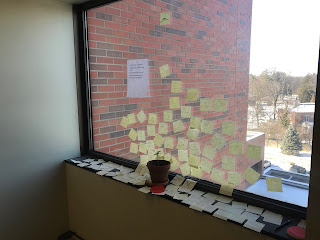
Clay pot with small plant surrounded with lots of sticky notesRupert's birthday

And today a large piece of paper appeared with an important announcement.
Save the date to celebrate! A big party for a resilient little plant. Rupert’s birthday is April 27th. Watch this space for more information coming soon.
After nine months, a simple conversation I started with an unknown person has expanded to include many more people. I’m guessing (based on handwriting) there have been a dozen or two different people who have participated in the conversation, and almost certainly many dozens more who have stopped for a moment and read the messages. A community of caring people has formed, although I have no idea who any of the other people are, and I suspect that is true for them as well. Yet we’ve all come together to nurture and encourage this one little plant, and dare I say, each other.

Is this about more than a plant?

So, what can we learn from this experience? What if we were to imagine that Rupert the red pepper plant was one of our students? Do we show as much care and concern for them? What if we don’t make the effort to help them to learn? Might they then shrivel up and withdraw, like Rupert?

How many times have we given up on a student that was too far behind to catch up, just wasn’t getting it, or was too needy? Once Rupert dropped all of his leaves, I suspect we all thought that was the end of the plant. Yet one of us decided to continue watering it. And a week later, new growth appeared. What if we keep working with those struggling students—who might have even given up on themselves—to help them through the tough parts of their days and lives, whether that be our course content, or helping them juggle priorities in their life. 

What if we involve others to help support the student as well, just like the community that has formed around Rupert. Then we can all celebrate the student’s success—completing an assignment, a course, a semester, or a degree—just like we’re going to celebrate Rupert’s birthday in a few weeks.

When asked what I do, I like to say that I strive to turn on light bulbs. By this I’m referring to those “ah ha” moments learners have when something suddenly makes sense. Maybe I also need to say that I strive to keep things adequately watered and nurtured.

How about you? What are you doing to nurture those with whom you come into contact?