Sunday, May 19, 2019

The empathy I gained while traveling

Picture of train ticket and a towel with "Don't panic" written on it.
The towel was a gift from a student. I take it on all my trips now.
Do you remember what it was like to first learn the body of knowledge which ultimately became your profession? So much of that initial learning is totally second-nature to us now, and we don’t even think about the fact that there was a time when we didn’t know it. We may have even forgotten how much we struggled to learn what seems trivial to us now. I suggest we need to have some empathy for our students' struggles.

Stay with me, while I relate a personal story to you. I’ll come back to empathy in a bit.

My wife and I have traveled to England, Scotland, and Ireland a few times, and thoroughly enjoyed each for many different reasons. Aside from the normal logistical challenges that arise, we found the trips and conversing with the locals rather easy. Obviously, the primary language spoken in England is English (although some of the words do have different meanings), but even in Scotland and Ireland, it is easier to converse in English than you might think.

Bayeux, France - Canal that runs through town
Bayeux, France
Last summer we ventured off of the islands onto the continent for our first time, traveling to parts of France and Germany for two weeks. Neither my wife or I speak French or German. We were assured by friends that—at least in the larger cities—this would not be a problem for us, and mostly that was true.
Bayeux, France - View of street from our apartment
View from our apartment in Bayeux, France

We started our visit to France in Bayeux, an old small town in Normandy on the northwestern coast. It is largely a tourist town, with a major attraction being visits to the various D-day and Normandy landing venues in the surrounding area. We stayed at a great Airbnb apartment in a multi-centuries-old building in the center of town. Being a tourist town, we had very few issues communicating with others. We enjoyed our time there and would have liked to have stayed a couple more days, but alas we had other reservations in Paris.

Our apartment in Paris, France
We boarded a train bound for Paris, where we had arranged to stay in another Airbnb apartment. This one was in Northeast Paris, far out into the residential suburbs. This was definitely not an area which catered to tourists, but it was wonderful to see this part of Paris as well. The apartment was great (complete with a washing machine, but no dryer), and was conveniently located just a few blocks from a Metro commuter train stop, which allowed us to get most anywhere we wanted to go. It provided a very cost-effective and pleasant way for us to stay in Paris.

By the time we arrived at the apartment the first evening, it was time for dinner. We also planned to eat our breakfasts in the apartment each morning and make our lunches to take with us each day. With a bit of research via information provided in the apartment by the owners, we figured out that there was a community square a few blocks from the apartment which had a few restaurants, but more importantly, a grocery store. Off we headed on, what seemed to us at the time, a simple mission—get dinner and buy groceries for the week.

Paris, France - Eiffel Tower
Paris, France - Notre Dame Cathedral
Now remember, we don’t speak French, and we’re in a residential area of Paris, where it is unusual to have lots of tourists. We hadn’t realized that yet, however. Since arriving in Paris earlier that day, we’d spent the afternoon in the center of Paris, with all the other tourists, and store clerks who spoke English well enough to communicate with us. After walking a few minutes, we arrived at the square, and located a viable take-out restaurant for dinner. We entered and proceeded to try to figure out what we wanted to eat. All of the signage was in French, and the workers didn’t speak English. Did I mention that we don’t speak French? Fortunately, there were pictures, and we eventually got something bought and took it out to sit in the square to eat. We both enjoyed what we had for dinner, but I’m still not sure what it was I ate that night. We were starting to realize we weren’t in Kansas anymore!

Next task: buy groceries. We entered the store and it looked encouragingly familiar; aisles of packaged food on shelves, and lots of fresh, unpackaged food. But again, no English signage, and of course the package labels are all in French. And as a reminder (wait for it…), we don’t speak French. Long story short, what should have been a 10- to 15-minute jaunt into the store to pick up a few breakfast and lunch supplies, along with other miscellaneous items turned into nearly an hour excursion. Google translate quickly became our friend! We successfully bought everything we needed, but it took us way longer than we expected it to. By the end of the week, I was recognizing a lot of French words and understanding what they meant. I was somewhat surprised how often I could make a reasonably correct guess about a French word because of an English word being (somewhat) similar.

I felt a bit isolated after my experience that evening. I realized that if I didn’t know what something meant, I was going to have to ask questions. But if I didn’t know how to, or what questions to ask, how could I do that? I did find that the local residents were very willing to help me understand, as long as I was trying to understand their language and use it when I could. Don’t get me wrong, I thoroughly enjoyed my time in France (and Germany), but this was my first time traveling when communication had been a challenge for me. I was experiencing something new and unfamiliar, and had to work through it.

Paris, France - Painting of "hieroglyphics" on the wall in a Metro commuter tunnel
Paris, France - Painting of "hieroglyphics" on the wall in a Metro commuter train tunnel
As I reflect on the experience I had that evening, I wonder if it is similar to what our students experience at the start of our introductory courses. They are being immersed in a topic they know little or nothing about. They have little context to which they can attached their new knowledge. We often use new terminology, or use their familiar words in different ways. They may know they have questions, but don’t believe they know enough to ask us questions. As someone who teaches an introductory computer programming course, I’m asking students to learn new concepts and to learn a new (programming) language, complete with its own (unusual) punctuation.

I came back last summer with a renewed appreciation for (some of) what it means to be a new student. We teachers need to remember that we haven’t always known everything we now know. There was a time we struggled to learn it, and that is the same struggle our students are having now. If we are to be effective guides in the learning process of others, we need to remember those first days when we were learning the material which we are now helping others master.

We need to have empathy and remember what it’s like to be in a foreign land and not know the language. How can we reach out and help these intrepid travelers we call students? Share your ideas below.

Saturday, May 18, 2019

Popular achievements in CS 222: Spring 2019 edition

As discussed in an earlier post, one of the assessible items in CS 222 (Advanced Programming) is something we call achievements. Achievements are designed to encourage student’s independent exploration of relevant course topics they choose from a provided list. Each student must complete a certain quantity of achievements if they expect to receive an A for the course, and reduced quantities for lower grades.

Originally, I set the threshold for an A at four achievements. To be more learner-centered, starting with the fall 2018 semester, the students collectively negotiated the threshold with me. Depending on the semester, it has been four or five achievements for the A level.

The list of available achievements has remained the same and are detailed in my previous post, with the addition of one new option this last year.
Learning to Learn: For discovering better ways to study. Visit the BSU Learning Center and talk with someone there about general study habits. Write an essay relating what you find to apply to CS course work.
The following table presents statistics from the most recent six semesters I’ve taught the course, along with a couple of summary columns. I find it interesting to look through the table to see what is popular (and what is not). For example, considering all semesters, the Diversity Seeker and Reflective Practitioner achievements have clearly been the most popular. Coming in next are the Crystallizer and Studious achievements. The order is slightly different if we just look at the last year, but it is still the same four achievements. Looking at individual semesters, the Judge, Rereader, and Seeker achievements have also been very popular. 
The recently-added Learning to Learn achievement has proven to be quite popular, and I suspect it will creep into the most popular list next year.

Five achievements (Campus Leader, Didact, Filmmaker, Jammer, and Open Source Contributor) have Continued to be the least popular. We have chosen to leave these as options for students with interest or skill in one of those areas. Note that the Third-part Librarian achievement was removed from the available options after the summer 2016 semester.

Lastly, I’ve found the number of achievements students choose to complete interesting. While a great many students do complete the required quantity, the majority do not. As shown in the table, the average for all semesters is just over three completed achievements per student. Due to a one-submission-per-week limitation, and their lack of planning, some students simply run out of time to get all of them submitted. The slight increase for the spring 2019 semester is likely due to the threshold for an A being at five, as compared to four for previous semesters.

I believe the achievement system continues to meet its intended purpose within the course. I do not observe any substantial changes in popularity compared to last year’s report. I will find it interesting to see if the popularity of individual achievements changes during the next year.

Wednesday, March 6, 2019

SIGCSE 2019: Where the inspired inspires the inspirer

Tie with SIGCSE 2019 name tagI attended my first SIGCSE Technical Symposium as a faculty member last week. I attended one other time, way back in 2010, when I was a graduate student. At that time, I delivered a Student Research Competition talk and poster about my thesis work related to small group development as it relates to software development teams. I also served as a student volunteer for the symposium. It was a great experience, but I only experienced part of the full event. This year, attending as a faculty member, I was able to experience the full gamut that SIGCSE has to offer, including being both giver and receiver.

One of the symposium co-chairs is a two-time graduate of Ball State University's Department of Computer Science. Manuel Pérez-Quiñones now serves as the Associate Dean of the College of Computing and Informatics at the University of North Carolina at Charlotte. I first met him when he returned to the Ball State campus a few years ago to deliver a keynote at a diversity research symposium. It was good to greet him again and deliver a “hello” from BSU.

Dave Largent, James McGuffee, Christian Roberson
Dave, Christian, and James
I was fortunate to have a workshop proposal about specifications grading accepted for presentation Wednesday evening, at the start of the symposium. (I've previously posted about specs grading.) James McGuffee (Christian Brothers University), Christian Roberson (Florida Southern College), and I jointly authored this proposal, and I am indebted to their help making it a reality. The material we presented resonated well for the thirty-plus workshop attendees, and I believe we made a few converts that evening. We had lots of great questions and discussion, with many attendees staying well past the 10:00 PM ending time discussing possible ways to implement specs grading in their courses. All in all, it was a great way to start the symposium off on a high note.

I enjoyed the keynote presentations. Marie desJardins (Simmons University in Boston) focused on inclusion in computing, ultimately discussing these “Five Pernicious Myths.”
“He was born to be a computer scientist.”
“Computer scientists are… {insert stereotype here}.”
“Anybody can be a computer scientist—girls just don’t want to.”
“It’s a joke—don’t you have a sense of humor?”
“’Diversity programs’ are just political correctness.”
Check out her presentation slides for a wealth of information and resources.

Gloria Townsend (DePauw University) provided a top-ten list that identified the most effective strategies used at DePauw to recently award 47% of their computer science undergraduate degrees to women. Her list included these items, many focusing on women:
10.  Celebrations
9.    Networking
8.    ACW-W chapter
7.    Mentoring
6.    Role modeling
5.    Outreach
4.    Content preview
3.    Social activities
2.    Female CS1 teachers
1.    Encouragement
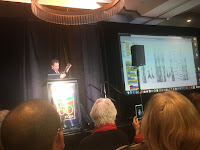
Mark Guzdial playing a ukulele
Mark playing a ukulele
Mark Guzdial (University of Michigan) delivered a keynote in which he posited that “teaching programming as a way to express ideas, communicate with others, and understand our world is one of the oldest goals for computing education,” and that “Computer Science was invented to be a tool for learning everything else.” His justification can be found in his presentation slides. At the end, he gave us a call to action to find our allies and grow the community, and to invent, mutate, and evolve. His blog is well worth your time, so take a look.

I first met Mark when he chaired my paper session at ICER 2010 in Aarhus, Denmark. This was my first international academic conference. To put things into perspective, I started my first semester of full-time teaching at a university a few days after the conference. I presented my thesis work related to small group development as it relates to software development teams. After collecting five years worth of data, I turned it into an ACM TOCE journal article. If I recall correctly, my table-mates for dinner that evening were Mark, Beth Simon, and someone from NSF, whose name I have long since forgotten. Talk about being out of my element! But they were all very gracious, and it was a great dinner. Beth and I talked about peer instruction and the use of clickers. I started using clickers that fall, but it was three more years before peer instruction made its way into my classrooms.
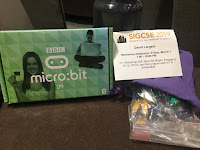
Micro:bit box and SIGCSE name tagI attended a variety of paper presentations and a workshop. Since this post is already lengthy, and I have one more big thing I want to share, I’m going to skip the details of the papers and the workshop. If you really want to know, ask me about them.

But wait; there's more...
My two presentations served as bookends for my symposium experience; I started with the specs grading workshop and ended Saturday morning by presenting a poster about the CS1 Art Show I’ve been coordinating for six years. For much of that time I anecdotally knew the show had a generally positive impact on our students, the department, and how others view us. This past summer I started collecting data, and now can more formally make that claim, with data to back it up. My poster presented some of that data and described the details and logistics of producing the art show. Included were student and judge comments.
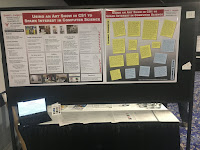
Poster about CS 1 art showI talked with a dozen or more people during my two-hour poster presentation who seemed genuinely interested in doing something similar with their own course. I remember one person exclaiming “This is exactly what I’ve been looking for!” All these interactions provided a wonderful affirmation that I did something good. But there were three visitors, in particular, who but me over the top, providing a great way to end my symposium experience.

In the fall of 2013 we started using the media computation textbook authored by Mark Guzdial and Barb Ericson. That same semester, I was inspired to hold an art show based on collages our CS1 students were creating for one of their course projects. The idea originated from an article by Beth Simon and Leo Porter about a similar event they produced. I took their idea and modified it to work in our environment.

Fast forward to a few days ago. I wondered if Mark, Barb, Beth, or Leo (all of whom I knew were present at the symposium) might be interested in my research about the art show, so I sent them all a message letting them know I was presenting my poster Saturday morning. They all expressed interest, indicating that they’d try to drop by my poster session, but some of them indicated they had busy schedules. As such, I wasn’t holding my breath.

To my delight Mark arrived and talked with me for 10-15 minutes. While reviewing the presented data, he seemed excited about how learner-centered and engaging the whole art show process is. After he left, Barb arrived a few minutes later. I was talking with another individual at the time, but she very patiently waited until they were done, spending time reviewing my poster. She also provided lots of encouragement about the art show project.

Idea light bulb
Image by rawpixel.com
It was getting close to the end of the poster session when Leo arrived. We talked at length about the logistics of how I run the show. The more we talked, the more excited he became, and the more questions he asked. I could see a light bulb starting to glow. Now remember, Leo originated the art show idea with Beth when he was serving as a Teaching Assistant at the University of California, San Diego (UCSD), and operationalized it while at Skidmore College. But, after moving back to UCSD, he was faced with very large class sizes, and dismissed the possibility of continuing the art shows. Now, after years away from the art show, he was seeing a way to make the process scale to larger class sizes. Maybe he could produce an art show with large class sizes at UCSD. The light bulb was definitely on at this point, and that made me very happy. What a way to end my SIGCSE Technical Symposium experience.
The inspired (me), had just inspired the inspirer!

Sunday, November 18, 2018

Lilly Conference reflections: 2018 edition

I spent the last three days at the 38th Original Lilly Conference on College Teaching at Miami University in Oxford, Ohio. This is the fourth time I’ve been able to attend this conference and have been privileged to present at the conference all four times as well. If you can afford the time and money, I highly recommend attending this conference held the weekend before Thanksgiving every year.
At my first Lilly (2013), I presented a poster with three of my colleagues (Rebecca Pierce, Lynne Stallings, and Petra Zimmermann) titled “Classroom Interaction Redefined: A Multidisciplinary Perspective on Moving Beyond Traditional Classroom Spaces to Promote Student Engagement.” We translated this into a journal article, which was recently published online.

In 2016, I talked about helping computer science students explore the issue of lack of diversity and inclusivity in our educational programs and profession. The last two years, I’ve talked about my experiences combining specifications grading with learner-centered teaching. I've blogged about specs grading here and here.

Every time I’ve attended Lilly, I’ve come away from the experience rejuvenated. When you spend time in conversations with others excited and interested in finding the best way to teach, how can you not become excited yourself? The conference attendees are a very friendly group of people. One has a sense of attending a homecoming and getting reacquainted with old friends when one attends Lilly.

Rather than try to detail everything I absorbed at the conference this year, I’m simply going to provide a list of very briefly annotated quotes I wrote down while listening to presenters. I’m not going into depth partly because I don’t have the time to do so right now, and partly because I’m yet to fully process most of what I experienced. They are presented here in the order in which I experienced them.
  • “Get more sleep.” We have to have adequate sleep for our brains to make memories.
  • “We can't solve our problems with the same thinking we used to create them.”  Time to think outside of the box.
  • “Give authority to students and be prepared to be amazed.” I’ve had this experience many times, as recently as a week ago with honors colloquium students.
  • “Memorizing is what you do when something doesn't make sense.” To truly learn something, it has to make sense.
  • “What would students do if we gave them wrong or missing instructions?” Should we do this to make them think and question?
  • “Students must have past knowledge to which they can connect the new information we give them.” Our brains store new information by attaching it to previous knowledge and experiences.
  • “Test for what you want your students to know a year from now.” If it’s not important enough that you want the student to know it a year from now, why test them on it? What does it matter if they know it now?
  • “Peer feedback should be thought of as reciprocal teaching, not an evaluation.” This changes the nature of the conversation.
  • “Flipped learning may not be evidenced by short term assessments gains but will be reflected in long term knowledge.” Learners can cram for a test and do well but are much less likely to remember it later. True learning is for the long term.
  • “We can’t change what we cannot see.” If we don’t know there is an issue, how could we know it needs changed? We have to look and observe.
  • “What are the things going on in our students lives? How might those things affect their learning? How could it change our teaching if we knew?” We must do more than simply teach content.
  • “Everything we do is a rehearsal for the future.” Extremely few things are ever done only once. Always strive to do better.
  • “Impatience is the enemy of empathy.” Take time to understand.
  • “Grades should be indicative of the quality and quantity of learning.” The key here is measuring learning, not testing.
Share your thoughts below. What quotes resonate with you? What ones raise questions? Do you find fault with any of them?